
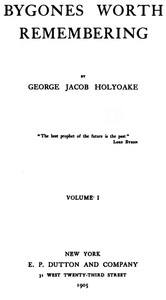
Bygones Worth Remembering, Vol. 1 (of 2) by George Jacob Holyoake
Let's be clear from the start: this is not a novel. If you're looking for a plotted story with a clear beginning, middle, and end, you won't find it here. 'Bygones Worth Remembering' is a collection of memories, anecdotes, and reflections from George Jacob Holyoake, a key figure in 19th-century British radicalism. He was a Chartist, a secularist who went to prison for his views, and a lifelong champion of the cooperative movement.
The Story
There's no single plot. Instead, Holyoake walks us through the major events of his life and the people he met along the way. He describes his trial and imprisonment for blasphemy with a startling lack of bitterness, focusing on the absurdity of the situation. He shares stories of building the early cooperative societies, brick by financial brick. He gives us vivid sketches of famous contemporaries like Richard Cobden and John Stuart Mill, not as statues, but as people he argued and worked with. The 'story' is the slow, difficult, often frustrating work of trying to change minds and build new institutions.
Why You Should Read It
I loved this book for its voice. Holyoake is refreshingly human and unpretentious. He's not trying to paint himself as a flawless hero. He gets tired. He admits when movements splintered or failed. His writing has a dry, observational wit that makes even descriptions of parliamentary procedure engaging. Reading this feels like sitting down with a sharp, elderly relative who has seen it all and has some incredible tales to tell. It completely demystifies history. You see that progress wasn't made by perfect icons, but by flawed, determined people showing up, making speeches, printing pamphlets, and sometimes just enduring.
Final Verdict
This book is a gem for readers who enjoy first-person history and biographies. It's perfect if you're interested in the roots of social reform, labor movements, or secular thought. It's also great for anyone who appreciates a well-told anecdote and a unique perspective from the margins of mainstream history. Be warned: it's a product of its time, so the prose can be dense in places. But if you stick with it, you'll be rewarded with a remarkably intimate and grounded look at a world of ideas in action. Think of it less as a book to study and more as a long, fascinating conversation across time.
Susan Flores
1 year agoSolid story.




Daniel Williams
1 year agoThanks for the recommendation.