
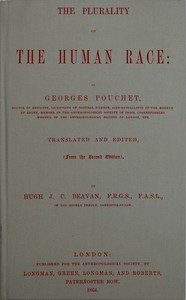
The plurality of the human race by G. Pouchet
Published in 1864, Georges Pouchet's The Plurality of the Human Race is a scientific manifesto that landed like a bomb in its time. Pouchet, a respected naturalist, wasn't just offering a theory; he was picking a fight with the dominant scientific and religious view of human origins.
The Story
There isn't a plot in the traditional sense. Instead, Pouchet builds an argument, brick by brick. His core idea is called 'polygenism': the belief that human races are distinct species with separate origins. He marshals evidence from anatomy, linguistics, and his interpretations of history to prove that a Black person from Africa and a White person from Europe couldn't possibly share a recent common ancestor. He argues against the opposing idea, 'monogenism' (a single origin for all humans), which was supported by both the biblical story of Adam and Eve and a growing number of his fellow scientists. The book is his detailed, passionate case for why everyone else is wrong.
Why You Should Read It
This book is a powerful, and often uncomfortable, history lesson. Reading it today, you know his conclusions are false and his ideas helped fuel racist ideologies. The value isn't in being convinced, but in observing the process. You see how 'objective' science can be shaped by the cultural biases of its time. Pouchet wasn't a cartoon villain; he was a serious scholar using the tools he had to explain the world. That's what makes it so compelling and chilling. It forces you to ask: what widely accepted 'facts' do we believe today that future generations will see as products of our own blind spots?
Final Verdict
This isn't a book for casual entertainment. It's for the intellectually curious reader who wants to understand the roots of scientific racism. It's perfect for history buffs, sociology students, or anyone interested in the messy, non-linear path of human knowledge. Approach it not as a source of truth, but as a primary document—a preserved specimen of a dangerous idea, meticulously argued. Be prepared for outdated language and concepts, but read it to see how easily science can stray when it forgets our shared humanity.
Robert Williams
1 year agoHaving read this twice, the narrative structure is incredibly compelling. Exceeded all my expectations.
Edward Jackson
1 year agoFive stars!







John Walker
3 months agoBased on the summary, I decided to read it and the atmosphere created is totally immersive. Definitely a 5-star read.