About 201 minutes
Tiger and Tom and Other Stories for Boys — Edition Insights
School Stories
46,156 recorded words. 0 minutes difference from this book's estimate.
View Gutenberg source #12591

The King's Daughter and Other Stories for Girls — Inside the Classic can be approached with a clearer sense of reading commitment from its source measurements: 46,216 words, 3 hr 21 min estimated reading time, and 8 detected text sections.
The text analysis averages about 17.5 words per sentence, while the detected sections provide another way to judge how the source is divided.
Project Gutenberg metadata also associates the work with “Christian life -- Juvenile fiction,” connecting these edition facts with the source record’s subject description.
Explore this collection
These alternatives are selected using recorded categories and estimated reading time.
About 201 minutes
School Stories
46,156 recorded words. 0 minutes difference from this book's estimate.
View Gutenberg source #12591About 136 minutes
School Stories
31,143 recorded words. 65 minutes difference from this book's estimate.
View Gutenberg source #11595About 90 minutes
School Stories
20,660 recorded words. 111 minutes difference from this book's estimate.
View Gutenberg source #35177Search stored excerpts and compare books → Choose by your preferences →
Choices use stored catalog measurements. Estimates vary with reading speed. A shared category is a catalog label, not a claim that two books have the same argument or literary quality.
Search reads excerpt text stored with this catalog and links to its associated Gutenberg record. The connection is stored in the site database; this tool does not recheck that every excerpt is word-for-word identical to that external record. Excerpt search does not cover every chapter and does not verify historical publication dates.
Catalog snapshot checked: 2026-09-26. Coverage: 91 public books, 91 available source excerpts.
Calculated from edition completeness, EPUB availability, text structure and catalogue metadata. Not a user rating.
Total of 100 points, scaled to a 2.5-5.0 range. Editions with an empty description or a missing EPUB file are not scored.
Public-domain source text
The source text is kept in the dedicated reader, separate from this catalogue record and its commentary.
The King's Daughter and Other Stories for Girls, published in 1910, is a collection of short tales each explicitly intended to convey a moral lesson, as the subtitle 'Every Story Contains an Important Lesson' announces. The stories range from domestic scenes of sibling generosity, as in 'Mopsey's Mistake,' to dramatic incidents like the coal mine accident in 'A Girl's Song.' Despite the catalog subjects emphasizing 'Christian life' and 'Conduct of life,' the excerpts reveal that many stories focus on practical ethics—sharing, honesty, and courtesy—rather than overt religious instruction. Prayer appears as a personal comfort, as when Patty in 'Patty's Secret' tells a hospital patient about her dream of Jesus, but the collection also includes secular tales of school life and family interactions.
The stories in this collection consistently embed moral lessons within relatable, everyday situations. In 'Mopsey's Mistake,' Louie learns about selfishness when her baby sister Grace offers her the larger candy stick, prompting Louie to promise, 'I won't never be such a greedy thing any more.' The lesson emerges from the child's own realization, not from adult admonishment. Similarly, 'Patty's Secret' shows a girl comforting a hospital patient by sharing her own experience of prayer, but the emphasis is on personal courage rather than doctrinal teaching. The catalog subject 'Christian life' is present, but the excerpts suggest that the stories often prioritize character development—honesty, kindness, and responsibility—over explicit religious content.
The excerpts display a surprising variety of settings for a collection aimed at girls. 'A Girl's Song' describes a coal mine disaster near Scranton, Pennsylvania, with a tense crowd of German miners and their families, a scene far removed from domestic life. In contrast, 'The Old Brown House' and 'How Bess Managed Tom' likely take place in homes or schools. The emotional register also varies: 'Mopsey's Mistake' is lighthearted, while 'Patty's Secret' deals with surgery and fear. This range suggests the collection offers more than simple moral tales, touching on real-world challenges and emotions. However, the excerpts are incomplete, so the full scope of settings and tones cannot be determined.
The narrative voice in the excerpts is direct and often conversational, addressing the reader as 'you' in 'Mopsey's Mistake' ('Can you guess why?'). Dialogue is used to reveal character and advance the moral, as when Louie speaks in baby talk ('Dis for 'ou') or Patty reassures the child with biblical quotation ('Lo, I am with you alway'). The language is simple but not simplistic, with occasional vivid details: Uncle Jack 'looking for all the world like a bear' or the miner's wives 'shivering with the cold.' The stories are short, typically focusing on a single incident that leads to a change of heart. This narrative economy makes the lessons clear without heavy-handed explanation.
Readers approaching this collection should expect a series of self-contained stories, each with a clear moral point, but with more variety in setting and tone than the catalog subjects might suggest. The tales are best read individually, allowing each lesson to stand on its own. The excerpts indicate that the book rewards attention to the small details of character and dialogue, which often carry the weight of the story's message.
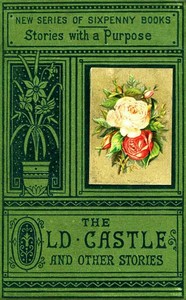
I remember the hush of that old 1910 girls’ book, where a child’s prayer or a scolding carries the weight of whole worlds. Such quiet lessons linger, much like the solid stones in The Old Castle and Other Stories — Text and Context. The Old Castle and Other Stories — Text and Context feels like an older, sturdier sibling to that first collection, dwelling in the same moral twilight, patient and unhurried.
Build a private reading journal entry for this title.