About 37 minutes
The Story of the White Mouse — A Reader’s Guide
School Stories
8,496 recorded words. 14 minutes difference from this book's estimate.
View Gutenberg source #30169
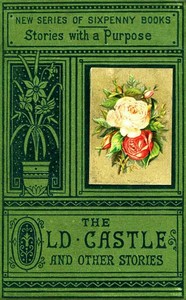
The Old Castle and Other Stories — Text and Context can be approached with a clearer sense of reading commitment from its source measurements: 11,591 words, 51 min estimated reading time, and 2 detected text sections.
The text analysis averages about 21.5 words per sentence, while the detected sections provide another way to judge how the source is divided.
Project Gutenberg metadata also associates the work with “Christian life -- Juvenile fiction,” connecting these edition facts with the source record’s subject description.
Explore this collection
These alternatives are selected using recorded categories and estimated reading time.
About 37 minutes
School Stories
8,496 recorded words. 14 minutes difference from this book's estimate.
View Gutenberg source #30169About 76 minutes
School Stories
17,396 recorded words. 25 minutes difference from this book's estimate.
View Gutenberg source #71823About 21 minutes
School Stories
4,645 recorded words. 30 minutes difference from this book's estimate.
View Gutenberg source #22539Search stored excerpts and compare books → Choose by your preferences →
Choices use stored catalog measurements. Estimates vary with reading speed. A shared category is a catalog label, not a claim that two books have the same argument or literary quality.
Search reads excerpt text stored with this catalog and links to its associated Gutenberg record. The connection is stored in the site database; this tool does not recheck that every excerpt is word-for-word identical to that external record. Excerpt search does not cover every chapter and does not verify historical publication dates.
Catalog snapshot checked: 2026-09-26. Coverage: 91 public books, 91 available source excerpts.
Calculated from edition completeness, EPUB availability, text structure and catalogue metadata. Not a user rating.
Total of 100 points, scaled to a 2.5-5.0 range. Editions with an empty description or a missing EPUB file are not scored.
Public-domain source text
The source text is kept in the dedicated reader, separate from this catalogue record and its commentary.
The collection opens not with a moral lecture but with a vivid domestic scene: a November evening, a glowing fire, and children resting after games. The narrator personifies the wind as having 'been visiting an iceberg,' a whimsical touch that sets the tone for the framed storytelling to come. Dudley Wylde, pressed to tell a true story about himself, begins with a confession of childhood jealousy—a pattern of self-revelation that recurs across the volume.
Each story in the collection hinges on a moment of social friction: a child's resentment at a cousin's arrival, a schoolgirl's exclusion because of her cheap calico dress, a poor family's quiet dignity. The settings shift from an English castle to a Westmoreland cottage to a schoolyard, but the emotional geography remains constant—characters are measured by their response to others' vulnerability.
The first story establishes a storytelling frame: children gathered in a parlour, each taking a turn. This device recurs in later tales, creating a sense of oral tradition. The narrator notes that the children 'had been having a splendid time' before the story begins, and the request 'let Dudley Wylde tell it' is met with unanimous enthusiasm. The frame allows for direct address—Dudley warns his tale 'won't be much to my credit'—and invites readers into the circle. The structure implies that stories are meant to be shared and that their value lies in the listener's response, not just the plot.
Across the excerpts, clothing signals status and moral character. In 'The Sixpenny Calico,' a schoolgirl's cheap dress draws whispered remarks: 'Why, I believe it is nothing but a sixpenny calico.' The narrator contrasts her own 'white hands and warm gloves' with Abby's 'purple fingers and cheap mittens.' Later, the narrator's 'new cloak, warm furs, and pink hat' become a source of pride during a walk through 'vulgar' streets. The stories repeatedly use fabric and fashion to expose social cruelty, then subvert those judgments by revealing the wearer's inner worth. The sick lady in the humble house, dressed plainly, is treated with respect by the narrator's mother—a quiet corrective to the schoolyard's coldness.
The stories frequently move characters from warm interiors into cold exteriors, or vice versa. The opening tale contrasts the 'charming fire' and 'heavy red curtains' of the parlour with the wind's 'dreadful story of an iceberg.' In 'The Sixpenny Calico,' the narrator steps from her warm home into 'less frequented thoroughfares,' then into a 'humble-looking house.' The cold is literal—Abby's purple fingers—and metaphorical, as social exclusion leaves characters standing apart on the playground. These transitions underscore the moral geography: comfort can breed complacency, while exposure to discomfort prompts reflection. The stories reward those who cross thresholds, whether into a poor home or into another's story.
The narrators of these stories often implicate themselves. Dudley begins by admitting his tale 'won't be much to my credit,' and the schoolgirl narrator confesses, 'As a sort of leader in school, my words were influential, and poor Abby was left out.' This pattern of self-criticism is unusual in children's literature of the period; it asks the reader to identify not with the virtuous but with the flawed. The first-person voice in 'The Sixpenny Calico' is particularly direct: 'How miserable I should be with such working hands and no gloves.' By exposing her own pettiness, the narrator models a kind of moral self-examination that the stories collectively encourage.
These stories reward attention to their small, telling details: the way a character hesitates on a threshold, the weight of a single remark, the texture of a calico dress. Readers may find it useful to note how each tale moves between comfort and discomfort, and how the narrators' self-awareness—or lack of it—shapes the moral. The collection offers not dramatic adventures but quiet reckonings, best read slowly and in sequence.
That feeling of being left out in the cold, wrapped in someone else’s judgment—it stayed with me after The Old Castle. Those quiet virtues, so easily overlooked, reminded me of the gentler fables in Rock A Bye Library: A Book of Fables Amusement for Good Little Children — Reading Companion. There’s a softness there, too, a patience I didn’t expect to find again.
Use these questions to collect your thoughts before moving on.