About 89 minutes
The olive branch, and other stories — A Reader’s Guide
Fairy Moral Tales
20,425 recorded words. 17 minutes difference from this book's estimate.
View Gutenberg source #77151
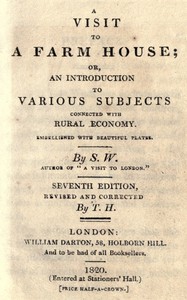
The catalog record for A visit to a farm house; or, An introduction to various subjects connected with rural economy. Seventh edition, revised and corrected. — Edition Insights provides practical reading context through 24,255 words, 1 hr 46 min estimated reading time, and 18 detected text sections.
The text analysis averages about 17.5 words per sentence, while the detected sections provide another way to judge how the source is divided.
Project Gutenberg metadata also associates the work with “Animals -- Juvenile fiction,” connecting these edition facts with the source record’s subject description.
Explore this collection
These alternatives are selected using recorded categories and estimated reading time.
About 89 minutes
Fairy Moral Tales
20,425 recorded words. 17 minutes difference from this book's estimate.
View Gutenberg source #77151About 150 minutes
Fairy Moral Tales
34,405 recorded words. 44 minutes difference from this book's estimate.
View Gutenberg source #77569About 59 minutes
Fairy Moral Tales
13,462 recorded words. 47 minutes difference from this book's estimate.
View Gutenberg source #74526Search stored excerpts and compare books → Choose by your preferences →
Choices use stored catalog measurements. Estimates vary with reading speed. A shared category is a catalog label, not a claim that two books have the same argument or literary quality.
Search reads excerpt text stored with this catalog and links to its associated Gutenberg record. The connection is stored in the site database; this tool does not recheck that every excerpt is word-for-word identical to that external record. Excerpt search does not cover every chapter and does not verify historical publication dates.
Catalog snapshot checked: 2026-09-26. Coverage: 91 public books, 91 available source excerpts.
Calculated from edition completeness, EPUB availability, text structure and catalogue metadata. Not a user rating.
Total of 100 points, scaled to a 2.5-5.0 range. Editions with an empty description or a missing EPUB file are not scored.
Public-domain source text
The source text is kept in the dedicated reader, separate from this catalogue record and its commentary.
The seventh edition of A Visit to a Farm House opens with the Benson brothers, newly arrived from London, waking to a bright morning and immediately venturing into the garden and adjoining field. The narrative moves swiftly from the house to the farmyard, where the boys encounter the cowman Ralph and observe milking. This initial scene establishes a pattern: each chapter introduces a rural subject—cows, sheep, bees, or crops—through the children's questions and the responses of their grandparents or servants. The structure is episodic, with each section functioning as a self-contained lesson framed by the brothers' curiosity.
The book repeatedly shifts its setting from the domestic interior to the working landscape. The Benson brothers begin indoors, then move to the garden, field, and farmyard. Later chapters return them to the house for meals or conversations, only to send them out again. This back-and-forth mirrors the rhythm of farm life itself, where the house and the fields are interdependent. The author uses these transitions to introduce new topics: a walk to the sheepfold leads to a discussion of wool, while a visit to the dairy prompts explanations of butter and cheese. The physical journey from one location to another becomes the narrative engine, carrying the reader along with the boys.
Throughout the excerpts, the children's initial fear of large animals is a recurring motif. When they first approach the cows, they stand at a distance, afraid. This cautious observation is repeated with other animals and unfamiliar sights. The author uses these moments to model a safe, respectful curiosity. The boys learn to overcome their fear by watching carefully and listening to explanations. The image of the cowman Ralph with his pail, or the grandfather pointing out details, reinforces the idea that knowledge comes from patient attention. The text does not simply describe rural scenes; it shows the process of becoming familiar with them.
In a notable structural departure, the grandfather tells the story of Harry Maddox, an idle boy who refuses to learn. This tale occupies several pages and follows Harry from school to apprenticeship, marriage, and eventual ruin. The narrative pauses the farm tour entirely, shifting to a past-tense moral exemplum. The story is framed by the brothers' questions, but it stands apart from the main setting. Its inclusion suggests that the book's purpose is not only to inform about rural economy but also to instill virtues like industry and diligence. The tale of Maddox serves as a negative example, contrasting with the attentive Benson brothers.
The book relies heavily on dialogue to convey information. The brothers ask questions, and the adults—grandfather, grandmother, or servants—provide answers. This format allows the author to present facts in a conversational, accessible manner. The dialogue also reveals the children's growing understanding. For instance, Charles's question about punishment after the Maddox story shows him internalizing the lesson. The exchanges are not merely didactic; they create a rhythm of inquiry and response that propels the narrative forward. The reader learns alongside the boys, and the dialogue keeps the tone lively despite the instructional content.
Readers approaching this seventh edition should attend to how the author balances direct instruction with narrative movement. The book is best understood as a series of linked scenes rather than a continuous plot. The shifts between domestic comfort and outdoor labor, between present observation and past anecdote, give the work its distinctive character. The editorial revisions by T. H. may have refined these transitions, but the underlying structure remains one of guided discovery through a carefully arranged sequence of encounters with rural life.
What stayed with me about that old farmhouse book wasn’t the lessons themselves, but how quietly the children moved between the kitchen’s warmth and the cold barn—how safety and risk shared the same ground. It reminded me of the restless hunt in The Rover Boys Shipwrecked; or, A Thrilling Hunt for Pirates' Gold — Background and Themes, where every discovered clue only deepens the loneliness of the search. I keep thinking about that.
Answer a few questions and save a private reflection on this device.