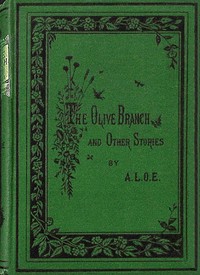
The olive branch, and other stories — A Reader’s Guide
Edition facts
The seventeen stories in this collection each pivot on a concrete object or scene—an olive branch, a furze thicket, a bird's nest—that serves as both title and narrative anchor. In the opening tale, an Italian peasant family's quarrel over a sister's peevish temper is framed by the child Rosina's desire to visit her aunt, with the olive branch itself never appearing but symbolizing the hoped-for reconciliation. The author, A. L. O. E., uses these focal points to ground moral lessons in tangible, everyday experiences, moving from domestic settings to historical anecdotes without losing the thread of the object's significance.
Objects as Narrative Hinges
Each story's title names an object that becomes the fulcrum of the plot. In The Olive-Branch, the branch is never physically present but represents the peace Rosina's mother yearns for with her sister. The Thicket of Furze uses a thorny bush as a metaphor for difficulties that must be faced bravely, as brother George tells Rosey that attending to small duties prepares one for greater ones. The Boy and the Bird's Nest likely centers on a nest as a symbol of care or temptation. This pattern recurs: the object is not decorative but functional, driving the characters' decisions and the moral argument.
Movement Between Domestic and Historical Scenes
The collection shifts abruptly from Italian peasant cottages to a German king's court. In The Olive-Branch, the setting is a village with a cow named Duchessa and goat-milk cheeses; the conflict is a family rift. Later, in the story told by Von Orlich, the scene moves to a monarch's cabinet where a page named Helden offers to suffer for his friend Carl. The king's harshness gives way to a hidden pardon. This juxtaposition—quiet domesticity versus royal power—shows the same moral principles (forgiveness, self-sacrifice) operating across vastly different social spheres.
Recurring Images of Light and Shadow
Facial expressions and light changes mark emotional turning points. In the first story, Rosina sees 'a shade of sadness gathering upon her father's sunburnt face' and her mother 'brushing a tear from her eye.' In the court tale, the king fixes his 'freezing gaze' on the page, then later his heart is 'touched.' The veteran Von Orlich gazes 'up into the blue starry heavens' as he feels gratitude. These visual cues—shadows, tears, starlight—create a consistent emotional vocabulary that signals shifts from conflict to resolution without explicit commentary.
Dialogue as Moral Instruction
Conversations carry the ethical weight. Carlo's stern 'Ask no questions, my child' and George's patient 'Many a duty is difficult' are typical: adults explain life lessons through direct speech. The embedded tale within The Olive-Branch is itself a dialogue between Von Orlich and Strasse, where the latter draws the moral: 'how apt we are to reserve all our gratitude for our fellow-man.' This layered storytelling—a story within a story within a collection—allows the author to model how moral reflection arises from shared narrative.
Readers will find that the stories reward attention to the objects named in the titles: they are not mere labels but keys to each tale's structure. The movement between humble homes and royal courts, and the recurring play of light and shadow on characters' faces, create a cohesive moral landscape. The collection is best read as a series of linked variations on forgiveness, duty, and gratitude, rather than as independent fables.