About 25 minutes
Cinderella — A Closer Reading
Fairy Moral Tales
5,612 recorded words. 5 minutes difference from this book's estimate.
View Gutenberg source #77727
The Child's Story-Book. Second Series—No. 4 — Context and Discussion can be approached with a clearer sense of reading commitment from its source measurements: 4,420 words, 20 min estimated reading time, and 1 detected text section.
The text analysis averages about 22.2 words per sentence, while the detected sections provide another way to judge how the source is divided.
Project Gutenberg metadata also associates the work with “Children's stories,” connecting these edition facts with the source record’s subject description.
Explore this collection
These alternatives are selected using recorded categories and estimated reading time.
About 25 minutes
Fairy Moral Tales
5,612 recorded words. 5 minutes difference from this book's estimate.
View Gutenberg source #77727About 40 minutes
Fairy Moral Tales
9,073 recorded words. 20 minutes difference from this book's estimate.
View Gutenberg source #43999About 59 minutes
Fairy Moral Tales
13,462 recorded words. 39 minutes difference from this book's estimate.
View Gutenberg source #74526Search stored excerpts and compare books → Choose by your preferences →
Choices use stored catalog measurements. Estimates vary with reading speed. A shared category is a catalog label, not a claim that two books have the same argument or literary quality.
Search reads excerpt text stored with this catalog and links to its associated Gutenberg record. The connection is stored in the site database; this tool does not recheck that every excerpt is word-for-word identical to that external record. Excerpt search does not cover every chapter and does not verify historical publication dates.
Catalog snapshot checked: 2026-09-26. Coverage: 91 public books, 91 available source excerpts.
Calculated from edition completeness, EPUB availability, text structure and catalogue metadata. Not a user rating.
Total of 100 points, scaled to a 2.5-5.0 range. Editions with an empty description or a missing EPUB file are not scored.
Public-domain source text
The source text is kept in the dedicated reader, separate from this catalogue record and its commentary.
The book opens with a dialogue between two children about stag-hunting, immediately establishing its moral and dialogic character. One child expresses horror at the cruelty, while the other explains that men hunt for pleasure—a claim the first child rejects, hoping for a time when cruelty ends. This exchange sets the pattern: short, naturalistic conversations that model ethical reasoning without overt preaching.
The second vignette, about a cat going under the grate, shifts to everyday observation. A child notes the cat's affectionate behavior, concluding that despite not understanding its purrs, the cat's happiness is enough. This blend of moral seriousness and domestic curiosity defines the book's tone.
The excerpts rely almost entirely on dialogue, with minimal narration. In “The Stag-Hunt,” two children debate the morality of hunting, with one child expressing disbelief that men could be so cruel. The other child explains that hunters think they find pleasure in the chase—a distinction that highlights the book’s interest in motives. Similarly, in “The Beggar,” a mother questions her son’s motive for giving a penny: did he give to be called good, or out of genuine compassion? The boy admits the former, and the mother gently corrects him. These exchanges are structured to lead young readers toward self-reflection rather than simply delivering a moral.
The vignettes are set in familiar domestic spaces—a fireside, a pond, a roadside—but they open onto larger ethical questions. In “The Little Ship,” a child imagines a pond as the Pacific Ocean and a toy ship as Captain Cook’s vessel, blending imaginative play with historical reference. The dialogue then shifts to factual information about Cook’s birthplace. This mix of fancy and fact is typical: the book uses concrete, child-scale scenarios to introduce ideas about cruelty, kindness, and knowledge. The cat under the grate, the stag’s broken heart, the beggar’s outstretched hat—each image is vivid and specific, grounding abstract lessons in tangible experience.
Across the excerpts, characters repeatedly ask why someone acts. In “The Stag-Hunt,” the question “what motive can they have?” drives the conversation. In “The Beggar,” the mother probes her son’s motive, distinguishing between approval-seeking and genuine charity. Even the cat’s behavior is interpreted: the child wonders what the cat “says” but decides that happiness is enough. This consistent attention to inner states—intentions, feelings, reasons—gives the book a psychological dimension unusual for such short pieces. The reader is trained to consider not just actions but the thinking behind them.
The child speakers are curious, sometimes naive, but never passive. In “The Stag-Hunt,” a child challenges the idea that hunting could be pleasurable. In “The Cat,” a child observes and interprets the cat’s behavior independently. Adults appear as interlocutors—a mother questioning her son, a father building a ship—but they do not dominate. The mother in “The Beggar” listens and asks questions rather than scolding. This balance gives the child’s perspective weight while allowing the adult to gently steer moral reasoning. The result is a series of conversations that feel like genuine exchanges, not lectures.
Because the excerpts represent only the opening portion of the book, the full range of its stories and moral lessons remains unknown. However, the pattern established here—short dialogues, ethical questioning, and a focus on motives—likely continues. Readers should expect each vignette to present a small moral puzzle rather than a simple rule. The book rewards attention to how characters reason aloud, and to the subtle differences between what they say and what they mean.
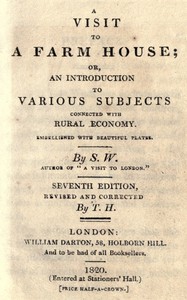
Reading these old lessons about motives and kindness, I found myself remembering how the world once felt slower. A visit to a farm house; or, An introduction to various subjects connected with rural economy. Seventh edition, revised and corrected. — Edition Insights holds that same quiet patience, where even a barnyard taught careful attention. I miss that unhurried reasoning, that gentle way of showing right from wrong without raising its voice.
Answer a few questions and save a private reflection on this device.