About 298 minutes
The Rover Boys Shipwrecked; or, A Thrilling Hunt for Pirates' Gold — Background and Themes
Fairy Moral Tales
68,368 recorded words. 2 minutes difference from this book's estimate.
View Gutenberg source #67893
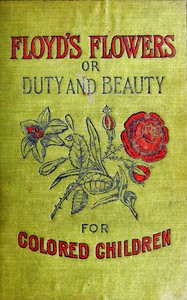
The catalog record for Floyd's Flowers; Or, Duty and Beauty for Colored Children Being One Hundred Short Stories Gleaned from the Storehouse of Human Knowledge and Experience: Simple — Key Ideas to Explore provides practical reading context through 68,891 words, 5 hr estimated reading time, and 106 detected text sections.
The text analysis averages about 17.6 words per sentence, while the detected sections provide another way to judge how the source is divided.
Project Gutenberg metadata also associates the work with “Conduct of life -- Juvenile fiction,” connecting these edition facts with the source record’s subject description.
Explore this collection
These alternatives are selected using recorded categories and estimated reading time.
About 298 minutes
Fairy Moral Tales
68,368 recorded words. 2 minutes difference from this book's estimate.
View Gutenberg source #67893About 232 minutes
Fairy Moral Tales
53,339 recorded words. 68 minutes difference from this book's estimate.
View Gutenberg source #67787About 150 minutes
Fairy Moral Tales
34,405 recorded words. 150 minutes difference from this book's estimate.
View Gutenberg source #77569Search stored excerpts and compare books → Choose by your preferences →
Choices use stored catalog measurements. Estimates vary with reading speed. A shared category is a catalog label, not a claim that two books have the same argument or literary quality.
Search reads excerpt text stored with this catalog and links to its associated Gutenberg record. The connection is stored in the site database; this tool does not recheck that every excerpt is word-for-word identical to that external record. Excerpt search does not cover every chapter and does not verify historical publication dates.
Catalog snapshot checked: 2026-09-26. Coverage: 91 public books, 91 available source excerpts.
Calculated from edition completeness, EPUB availability, text structure and catalogue metadata. Not a user rating.
Total of 100 points, scaled to a 2.5-5.0 range. Editions with an empty description or a missing EPUB file are not scored.
Public-domain source text
The source text is kept in the dedicated reader, separate from this catalogue record and its commentary.
Silas X. Floyd's Floyd's Flowers; Or, Duty and Beauty for Colored Children (1905) opens with a publisher's note that frames the author as an ideal speaker to "colored boys and girls of the South," a role shaped by his work as a teacher, Sunday-school missionary, and pastor. The book's subtitle promises stories that are "Simple, Amusing, Elevating," and the excerpts bear out this tripartite aim: each tale is a compact vehicle for moral instruction, often closing with a direct lesson. Floyd's authorial voice is that of a patient instructor who addresses his readers as "boys and girls," weaving in quotations from figures like Henry Ward Beecher and James A. Garfield to lend authority to his points.
Floyd consistently speaks to his readers in the second person, a choice that turns each story into a classroom encounter. In the excerpt on self-help, he writes that children should be taught "to think for themselves, speak for themselves and act for themselves," a triplet that echoes the cadence of a schoolroom lecture. This direct address is not merely stylistic; it enacts the book's pedagogical mission. The author positions himself as a mentor who knows his audience's circumstances, referring to "the home and the public school" as the two great agencies for teaching self-reliance. The effect is intimate and prescriptive: Floyd does not simply tell a story; he tells his readers what to learn from it.
Floyd frequently bolsters his lessons with extended quotations from respected figures. In the story "Henry Ward Beecher's Testimony," he reproduces a long passage from Beecher's 1874 sermon "Soul Power," in which Beecher describes being influenced as a child by "a poor old colored man named Charles Smith." Floyd then comments, "What noble testimony this is! And from what a noble source!" This technique serves two purposes: it provides a concrete example of the influence Floyd wants to instill, and it borrows the authority of a famous white preacher to validate the moral worth of a Black working man. The quotation is not decorative; it is the core of the lesson, and Floyd's exclamatory response models the reverence he expects from his readers.
Two themes recur across the excerpts: the power of influence and the necessity of self-help. Floyd asserts that "all of us have what is called influence, and, consciously or unconsciously, we are all influencing others, especially the young." This idea is dramatized in Beecher's story, where Charles Smith's quiet piety shapes a future abolitionist. The self-help motif appears in the lesson that children must learn "to help themselves" before they can help others. Floyd presents these not as abstract ideals but as practical steps: "First, learn to help yourself, and then you will be able to see more clearly how to help others." The repetition of these concepts across stories suggests a deliberate curriculum of character formation.
Floyd's diction oscillates between plain, colloquial phrasing and formal, sermon-like rhetoric. He uses words like "gleaned," "storehouse," and "elevating" in the subtitle, and in the text he employs balanced sentences and exclamatory flourishes ("What noble testimony this is!"). Yet he also writes simply: "I mean Henry Ward Beecher." This range reflects the book's dual audience—children who need clear instruction and adults who might read aloud. The illustrations by John Henry Adams, a professor of art at Morris Brown College, complement the text's aim to present African American life with dignity. Floyd's language consistently frames moral growth as an achievable, even joyful, pursuit.
Readers approaching Floyd's Flowers will find a work that is less a collection of stories than a series of moral lessons wrapped in narrative. Floyd's authorial choices—direct address, borrowed authority, and recurring themes—create a consistent voice that instructs without condescension. The book rewards attention to its rhetorical structure: each story builds toward a stated moral, and the quotations from figures like Beecher serve as both evidence and inspiration. For those interested in early 20th-century African American children's literature, this volume offers a clear example of how one educator sought to shape character through print.
There’s something tender about Floyd’s gentle insistence that beauty and duty belong to children—that their small choices ripple outward. I kept thinking how those lessons echo even in adventure, like the scrappy brotherhood in The Rover Boys Shipwrecked; or, A Thrilling Hunt for Pirates' Gold — Background and Themes, where loyalty carries the day as quietly as any moral tale. Old books, new warmth.
Build a private reading journal entry for this title.