About 25 minutes
Uncle Wiggily's funny auto — Story, Setting & Ideas
Young Readers
5,683 recorded words. 4 minutes difference from this book's estimate.
View Gutenberg source #70783
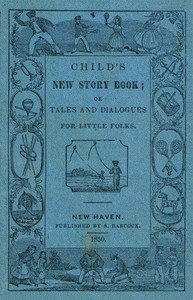
For Child's New Story Book; Or, Tales and Dialogues for Little Folks — Inside the Classic, the stored edition analysis reports 4,628 words, 21 min estimated reading time, and 1 detected text section.
The text analysis averages about 24.2 words per sentence, while the detected sections provide another way to judge how the source is divided.
Project Gutenberg metadata also associates the work with “Children's stories,” connecting these edition facts with the source record’s subject description.
Explore this collection
These alternatives are selected using recorded categories and estimated reading time.
About 25 minutes
Young Readers
5,683 recorded words. 4 minutes difference from this book's estimate.
View Gutenberg source #70783About 26 minutes
Young Readers
5,851 recorded words. 5 minutes difference from this book's estimate.
View Gutenberg source #72607About 27 minutes
Young Readers
6,195 recorded words. 6 minutes difference from this book's estimate.
View Gutenberg source #70627Search stored excerpts and compare books → Choose by your preferences →
Choices use stored catalog measurements. Estimates vary with reading speed. A shared category is a catalog label, not a claim that two books have the same argument or literary quality.
Search reads excerpt text stored with this catalog and links to its associated Gutenberg record. The connection is stored in the site database; this tool does not recheck that every excerpt is word-for-word identical to that external record. Excerpt search does not cover every chapter and does not verify historical publication dates.
Catalog snapshot checked: 2026-09-26. Coverage: 91 public books, 91 available source excerpts.
Calculated from edition completeness, EPUB availability, text structure and catalogue metadata. Not a user rating.
Total of 100 points, scaled to a 2.5-5.0 range. Editions with an empty description or a missing EPUB file are not scored.
Public-domain source text
The source text is kept in the dedicated reader, separate from this catalogue record and its commentary.
The anonymous author of Child's New Story Book opens with a poem promising to mould "little hearts to duty" and teach truths as faculties unfold "like flowers." This blend of moral instruction and natural imagery sets the tone for six tales that pair concrete objects—a cork ship, a sea shell, a white rabbit—with lessons in geography, patience, and kindness. The stories are structured as dialogues between children and adults, where questions prompt factual answers (Captain Cook's birthplace) or reflective responses (the shell's "whisper of the sea"). The 1849 publication date places it in a tradition of domestic moral tales, but the author's attention to sensory detail—the shell's pink tint, the feel of rain-washed pebbles—gives the vignettes a quiet specificity.
Each tale centers on a tangible item that carries symbolic weight. In "The Little Ship," a cork vessel becomes a vehicle for geography lessons about the North-Pacific Ocean and the Friendly Islands. The shell in "The Little Girl and the Shell" is explicitly linked to an absent uncle's promise, making it "precious" and its sound preferable to "sweet music." Susan's white rabbit and the pet robin likely serve similar functions, though the excerpts are incomplete. The author consistently uses these objects to ground abstract concepts—duty, memory, hope—in something a child can hold. This technique avoids overt preaching; instead, the moral emerges through the child's relationship with the object. The little girl's "settled calm" while listening to the shell suggests an interiority that the author respects, even in a brief sketch.
The stories rely heavily on question-and-answer exchanges between adults and children. In "The Little Ship," an adult asks, "Do you know where Captain Cook was born?" and the child replies with precise facts: "Marton, a village in the North Riding of Yorkshire." This pattern recurs in "Robert and John," where the boys' journey to school is described in detail—lane, elm trees, hawthorn hedge, churchyard, grove—but the moral lesson likely comes through parental commentary. The dialogues are not naturalistic; they are pedagogical scripts. Yet the author varies the tone: the shell scene is more lyrical, with the child's explanation unfolding in a single, flowing sentence. The contrast between factual recitation and emotional reflection suggests the author's awareness that different lessons require different modes of address.
The author invests in precise, sensory descriptions of settings. "Robert and John" begins with a detailed route: "a pleasant lane, with tall elm trees on one side, and a hawthorn hedge on the other; then across two fields; then through a churchyard." This specificity creates a vivid, almost map-like mental image. Similarly, the little girl sits "on a low seat by the fire-side" with a shell "faintly tinted with pink." These details are not merely decorative; they root the moral lessons in a recognizable domestic and natural world. The frosty morning of another tale likely offers similar atmospheric grounding. By anchoring each story in a particular time and place—a May morning, a fireside evening—the author gives the abstract lessons a concrete, memorable context. This attention to the physical environment is one of the collection's quiet strengths.
The catalog subjects list siblings as a key theme, and the excerpt from "Robert and John" hints at a contrast between the two brothers. John loiters to gather flowers and pebbles, while Robert presumably proceeds dutifully. This setup suggests a familiar moral binary: the diligent child versus the distracted one. However, the author does not condemn John's curiosity outright; the pebbles are described as "smooth" and "washed clean by the rain," implying an aesthetic appreciation. The tension between duty and delight runs through several tales. In "The Little Girl and the Shell," the child's listening is framed as a form of obedience to her uncle's instruction, yet her pleasure is genuine. The author seems to allow for moments of innocent absorption, even as the overall structure rewards good conduct.
Readers will find that the brevity of these tales—the entire book runs just over 4,600 words—belies their layered approach to moral education. The anonymous author balances factual instruction with emotional resonance, using everyday objects and sibling interactions to explore themes of duty, memory, and curiosity. Pay attention to the recurring motif of listening: to shells, to adults, to the natural world. The stories reward a slow, attentive reading that mirrors the calm they seek to instill.
There’s something steady about the old lessons in Child’s New Story Book—small voices figuring out kindness through simple talks. It reminded me, strangely, of another worn volume on my shelf, where a young person faces a wider, saltier world. Both share that earnest, unhurried trust in experience. That quiet sense of growing is why I pulled out The naval cadet: A story of adventures on land and sea — Edition Insights afterwards, just to hold the feeling a little longer.
Capture what you thought, learned, and would like to remember.