About 321 minutes
Roger the ranger: A story of border life among the Indians — Edition Insights
Childrens Adventures
73,705 recorded words. 28 minutes difference from this book's estimate.
View Gutenberg source #68694
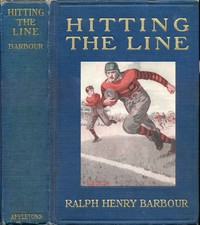
For Hitting the line — Inside the Classic, the stored edition analysis reports 80,145 words, 5 hr 49 min estimated reading time, and 32 detected text sections.
The text analysis averages about 13.7 words per sentence, while the detected sections provide another way to judge how the source is divided.
Project Gutenberg metadata also associates the work with “Teenage boys -- Juvenile fiction,” connecting these edition facts with the source record’s subject description.
Explore this collection
These alternatives are selected using recorded categories and estimated reading time.
About 321 minutes
Childrens Adventures
73,705 recorded words. 28 minutes difference from this book's estimate.
View Gutenberg source #68694About 305 minutes
Childrens Adventures
69,997 recorded words. 44 minutes difference from this book's estimate.
View Gutenberg source #69463About 301 minutes
Childrens Adventures
69,126 recorded words. 48 minutes difference from this book's estimate.
View Gutenberg source #76142Search stored excerpts and compare books → Choose by your preferences →
Choices use stored catalog measurements. Estimates vary with reading speed. A shared category is a catalog label, not a claim that two books have the same argument or literary quality.
Search reads excerpt text stored with this catalog and links to its associated Gutenberg record. The connection is stored in the site database; this tool does not recheck that every excerpt is word-for-word identical to that external record. Excerpt search does not cover every chapter and does not verify historical publication dates.
Catalog snapshot checked: 2026-09-26. Coverage: 91 public books, 91 available source excerpts.
Calculated from edition completeness, EPUB availability, text structure and catalogue metadata. Not a user rating.
Total of 100 points, scaled to a 2.5-5.0 range. Editions with an empty description or a missing EPUB file are not scored.
Public-domain source text
The source text is kept in the dedicated reader, separate from this catalogue record and its commentary.
Ralph Henry Barbour's Hitting the Line (1917) opens not on a football field but at a New York terminal, where two boys alight from a surface car, suitcases in hand. The narrator immediately adopts a mock-Sherlockian tone, proposing a treatise on evidence from hand luggage. This playful voice, however, quickly gives way to a pattern that governs the entire novel: movement between scenes is almost always accomplished by train. The story shuttles characters from city to boarding school, from campus to away games, and back again, with railway stations and carriages serving as transitional spaces where alliances form and tensions simmer.
The novel's thirty-two chapters are linked by a recurring motif of railway journeys. In the opening chapter, the boys' arrival by surface car and their subsequent train trip to Grafton School establish travel as the primary means of scene change. Later, the team travels by barge to the railway station before the Middleton game, and the narrative pauses to note a delay at Needham Junction. These details are not mere filler; they structure the story's rhythm, separating school life from athletic contests. The train becomes a threshold between the ordinary and the extraordinary, between study hall and the gridiron. Barbour uses these transitions to compress time and to signal shifts in mood, from the anticipation of departure to the exhaustion of return.
Barbour pays close attention to the spaces where players recover and reflect. After a grueling practice, Monty Crail and Luderus walk side by side to the field house, still panting, and talk over their contest in a detached manner. The locker room is where Monty becomes suddenly aware that he is extremely tired and very sore in many places. These interior scenes provide a counterpoint to the public drama of the game, allowing characters to speak candidly about their performance and their limits. The physical aftermath—stiffness, exhaustion, the quiet acknowledgment of defeat—is rendered with specificity, grounding the athletic heroics in bodily reality.
The football sequences are built around a clear structural logic: the game progresses through substitutions and positional battles. In the Middleton game, Barbour lists the starting line-up in detail—Derry at left end, Tray at right, Spalding and Hanrihan at tackles—and then tracks substitutions as the contest unfolds. The fourth period witnesses the vanquishment of both Monty and Luderus, who literally played themselves out and were sent off together. This emphasis on rotation and replacement reflects the novel's interest in the team as a system, where individual effort is subsumed into a larger pattern of attack and defense. The play-by-play is brisk, focusing on gains, losses, and the occasional trip over one's own feet.
Two physical objects recur with emblematic force: the pigskin and the measuring tape. The ball is described as being taken from forty-five yards to twenty-three, swept back, or carried in bewildering runs. The tape appears when a runner trips and the distance must be determined by an inch or so. These objects anchor the abstract contest in tangible things. The pigskin is a prize to be advanced; the tape is an arbiter of inches. Barbour's prose treats them with matter-of-fact precision, avoiding metaphor in favor of functional description. This restraint gives the football scenes a documentary quality, as if the reader is watching from the sidelines alongside the substitutes.
Readers approaching Hitting the Line will find a story that moves as much by train as by foot. Pay attention to the spaces between the games—the stations, the field house, the locker room—where Barbour does some of his most effective character work. The novel's structure rewards a reader who notices how journeys frame the action and how physical exhaustion speaks louder than victory speeches.
I’ve always admired how Barbour’s football novel finds its rhythm between the rattle of the train and the hush of the locker room. It’s a quiet balance of journey and arrival, much like the summer idyll in The Y. M. C. A. boys on Bass Island — Inside the Classic, where boys drift between water and shore, each scene a gentle stepping stone. Both books share that patient, unhurried pulse of youth.
Answer a few questions and save a private reflection on this device.