About 178 minutes
Playmate Polly — Context and Discussion
Childrens Adventures
40,890 recorded words. 0 minutes difference from this book's estimate.
View Gutenberg source #73707
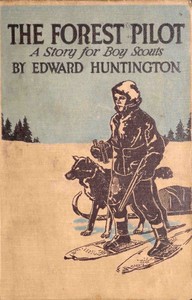
The source record for The Forest Pilot: A Story for Boy Scouts — Story, Setting & Ideas measures this digital text at 40,864 words, 2 hr 58 min estimated reading time, and 15 detected text sections.
The text analysis averages about 22.2 words per sentence, while the detected sections provide another way to judge how the source is divided.
Project Gutenberg metadata also associates the work with “Shipwrecks -- Juvenile fiction,” connecting these edition facts with the source record’s subject description.
Explore this collection
These alternatives are selected using recorded categories and estimated reading time.
About 178 minutes
Childrens Adventures
40,890 recorded words. 0 minutes difference from this book's estimate.
View Gutenberg source #73707About 183 minutes
Childrens Adventures
41,934 recorded words. 5 minutes difference from this book's estimate.
View Gutenberg source #73660About 186 minutes
Childrens Adventures
42,647 recorded words. 8 minutes difference from this book's estimate.
View Gutenberg source #70295Search stored excerpts and compare books → Choose by your preferences →
Choices use stored catalog measurements. Estimates vary with reading speed. A shared category is a catalog label, not a claim that two books have the same argument or literary quality.
Search reads excerpt text stored with this catalog and links to its associated Gutenberg record. The connection is stored in the site database; this tool does not recheck that every excerpt is word-for-word identical to that external record. Excerpt search does not cover every chapter and does not verify historical publication dates.
Catalog snapshot checked: 2026-09-26. Coverage: 91 public books, 91 available source excerpts.
Calculated from edition completeness, EPUB availability, text structure and catalogue metadata. Not a user rating.
Total of 100 points, scaled to a 2.5-5.0 range. Editions with an empty description or a missing EPUB file are not scored.
Public-domain source text
The source text is kept in the dedicated reader, separate from this catalogue record and its commentary.
From its first paragraph, The Forest Pilot anchors the reader in a specific, threatening weather system: the November sun 'red and threatening,' the wind shifting 'suddenly to the northeast, coming as a furious blast.' The prose is lean and functional, favoring concrete nouns—'schooner yacht,' 'jagged, rocky shore line,' 'cork'—over decorative adjectives. This economy extends to the dialogue, where the old hunter Martin MacLean delivers instructions on snaring rabbits or walking on snow-shoes with the clipped authority of someone who has spent decades in the woods. The novel’s voice is that of a practical manual wrapped in a survival story, and its sentences often move with the same deliberate, gliding rhythm Martin teaches Larry to use on snow-shoes.
The narrator’s vocabulary consistently reflects Martin MacLean’s world. Words like 'gale,' 'crust,' 'snare,' 'notch,' and 'header' (for a fall on snow-shoes) are not merely decorative but carry the weight of lived knowledge. When Martin explains rabbit snares, the description is almost technical: 'The notch is cut deep enough to hold the bent limb, but not firmly enough but what it can be jerked loose pretty easily.' The sentence structure itself mimics the careful cause-and-effect of the trap. This is not a generic adventure; it is a story in which knowing the right word—'crust' versus 'snow,' 'snare' versus 'trap'—can mean the difference between food and starvation. The author trusts that the reader will follow these specifics, and the result is a texture of authenticity that generic wilderness prose lacks.
Conversations in the excerpts serve a dual purpose: they advance the plot and double as survival lessons. Martin’s speech is peppered with imperatives and explanations: 'Now watch me while I run out to that tree and back,' or 'I’ll teach you a dozen ways to make snares.' Larry’s responses are often brief—'But—' or 'Oh, nothing'—revealing a boy who is absorbing more than he admits. The dialogue is never idle; even Martin’s joke about 'grandest headers' carries an implicit lesson about the difficulty ahead. This instructional quality gives the exchanges a rhythm of demonstration and emulation, mirroring the mentor-apprentice dynamic central to the Boy Scout ethos of the period. The author avoids melodrama, letting the practical details of snow-shoe technique or snare construction carry the emotional weight of the relationship.
The Labrador coast is not a backdrop but a force that shapes every action. The opening storm is described through its effects on the yacht—'dancing about like a cork'—and on the captain’s worried face. Later, the snow 'crust' determines whether travel is possible, and the forest is a place of precise hazards: wolves, moose, blizzards. The author uses sensory details sparingly but effectively: the 'furious blast' of wind, the 'barking excitedly' of dogs on snow-shoes, the 'munching' of bacon and biscuit. These details ground the reader in a physical world where weather and terrain are not ornamental but decisive. The setting is never merely described; it is always something to be read, interpreted, and responded to—a pilot’s landscape.
The chapter titles—'The Storm,' 'The Home on the Rocks,' 'The First Supper,' 'Lessons in Piloting'—announce a pattern of crisis followed by instruction. Within chapters, the narrative alternates between action (the storm, the blizzard) and quiet, detailed exposition (how to set a snare, how to walk on snow-shoes). This alternation creates a rhythm of tension and release, but also reinforces the book’s central idea: survival depends on methodical learning. The prose itself repeats key phrases—'the old hunter said,' 'Larry made no reply'—establishing a cadence that feels almost ritualistic. This structural choice mirrors the repetitive practice required to master a skill, and it gives the novel a distinctive, unhurried pace that sets it apart from more frantic adventure stories.
Notably, the narrative rarely enters Larry’s thoughts directly. His feelings are inferred from actions—'bursting with suppressed laughter' when he races Martin, or the evasive 'Oh, nothing' when asked about his fears. The authorial choice to keep the boy’s interior life at a distance forces the reader to attend to external details: the set of a jaw, the speed of a step, the tone of a reply. This restraint aligns with the book’s emphasis on observable competence over emotional confession. It also reflects the period’s literary conventions for boys’ adventure fiction, where character is revealed through deeds rather than introspection. The result is a narrative voice that is steady, almost stoic, matching the old hunter’s own demeanor.
Readers approaching The Forest Pilot will find a story that rewards attention to practical detail. The pleasure lies not in dramatic twists but in watching a boy learn to read the forest—its crusts, its snares, its silences—under the tutelage of a man who has spent a lifetime doing so. The novel is best read slowly, the way one might follow a trail, noting each step. It is a book about the patience required to become competent, and its prose embodies that patience on every page.
That rainy afternoon, the Labrador fog in The Forest Pilot felt so close I could smell the spruce. It wasn’t the adventure that stayed with me, but the old hunter’s patient, wordless trust in the boy. Later, idly, I found myself thinking about another quiet pupil—and opened A little Swiss boy — Story, Setting & Ideas. Different mountains, same gentle faith in growing up slowly.
Your answers remain private and are stored only in this browser.