About 19 minutes
My twin puppies — Inside the Classic
Childrens Adventures
4,172 recorded words. 0 minutes difference from this book's estimate.
View Gutenberg source #68254
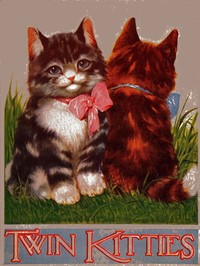
My twin kitties — A Reader’s Guide can be approached with a clearer sense of reading commitment from its source measurements: 4,323 words, 19 min estimated reading time, and 1 detected text section.
The text analysis averages about 17.7 words per sentence, while the detected sections provide another way to judge how the source is divided.
Project Gutenberg metadata also associates the work with “Animal welfare -- Juvenile fiction,” connecting these edition facts with the source record’s subject description.
Explore this collection
These alternatives are selected using recorded categories and estimated reading time.
About 19 minutes
Childrens Adventures
4,172 recorded words. 0 minutes difference from this book's estimate.
View Gutenberg source #68254About 24 minutes
Childrens Adventures
5,305 recorded words. 5 minutes difference from this book's estimate.
View Gutenberg source #68563About 33 minutes
Childrens Adventures
7,418 recorded words. 14 minutes difference from this book's estimate.
View Gutenberg source #76014Search stored excerpts and compare books → Choose by your preferences →
Choices use stored catalog measurements. Estimates vary with reading speed. A shared category is a catalog label, not a claim that two books have the same argument or literary quality.
Search reads excerpt text stored with this catalog and links to its associated Gutenberg record. The connection is stored in the site database; this tool does not recheck that every excerpt is word-for-word identical to that external record. Excerpt search does not cover every chapter and does not verify historical publication dates.
Catalog snapshot checked: 2026-09-26. Coverage: 91 public books, 91 available source excerpts.
Calculated from edition completeness, EPUB availability, text structure and catalogue metadata. Not a user rating.
Total of 100 points, scaled to a 2.5-5.0 range. Editions with an empty description or a missing EPUB file are not scored.
Public-domain source text
The source text is kept in the dedicated reader, separate from this catalogue record and its commentary.
The story opens with a playful twist on the nursery rhyme: two kittens that did not wear mittens, only coats—one yellow, one black. The narrator immediately establishes a pattern of repetition and contrast, pairing the kittens' identical features (blue eyes, scratchy claws) with their lack of names and home. This rhythmic, almost chant-like prose sets a tone that is both simple and deliberate, inviting young readers to notice similarities and differences.
The kittens' quest for a home and two pretty names drives the early action. Each door they knock on yields a different response—a cross old lady, a hobblety old gentleman, and finally a dear little girl named Irene. The escalating cries of "Meow!" and the repeated phrase "My how they ran!" create a predictable structure that rewards anticipation. By the time Irene names them Fluff and Puff, the reader has already been primed to expect symmetry and resolution.
The text relies heavily on repeated phrases and parallel sentence structures, which serve as signposts for early readers. The opening line echoes "Three Little Kittens" but subverts it: these kittens have no mittens, only coats. The refrain "They had nothing to eat but mice! / They had nothing to lie on but hay!" uses exclamation points to emphasize deprivation, while the triple knock on doors—each with a different adult response—builds a rhythm that makes the story easy to follow aloud.
Notice how the narrator repeats "My how they ran!" after each rejection, reinforcing the emotional arc from hope to fear. Later, when Fluff climbs the curtain, Irene's comment "You'll never find milk or mice on the ceiling" echoes the earlier food motif. This verbal patterning is not merely decorative; it helps a child anticipate what comes next and recognize when a lesson is being taught.
Deihl restricts the narrative to what the kittens see and feel, without granting them full human understanding. They are driven by basic needs—food, rest, a name—and their reactions are physical: they run, they purr, they meow. When they try to jump on the couch after their bath, the lady says they are too dirty, and the kittens do not argue; they simply submit to being scrubbed.
This limited viewpoint creates opportunities for gentle humor. Fluff climbs the curtain not out of mischief but because she is used to the barn and does not know that curtains are not trees. Irene's line "You'll never find milk or mice on the ceiling" gently corrects without scolding. The reader is positioned slightly above the kittens, able to see their mistakes while still sympathizing with their confusion.
Irene is the first human to welcome the kittens, and her actions define the story's moral framework. She does not simply take them in; she insists on bathing them, naming them, and later rescuing Fluff from the curtain. The mother nods approval but remains in the background, providing authority without dominating the scene.
Irene's knitting a blue scarf is a small but telling detail: it suggests a domestic, patient activity that contrasts with the kittens' impulsive energy. When she leaves the scarf on the couch and hears a scamper, the reader can infer mischief without needing explicit description. Irene's role is to mediate between the kittens' barn instincts and the rules of a house, making her a relatable figure for child readers who are themselves learning household boundaries.
The story opens on a farm where kittens are ignored, eating only mice and sleeping on hay. The world beyond is described as "long, dusty roads" leading to "little white cottages nestled down among the green trees." This shift from open, neglected space to enclosed, cared-for home is central to the plot.
Once inside, the kittens encounter new rules: no jumping on furniture when dirty, no climbing curtains. The house is a place of baths, soft cloths, and knitting—a world of comfort but also constraint. The contrast is not heavy-handed; it emerges through small details like the lady saying "No, you are too dirty" before the bath, or Irene looking up to find Fluff stuck on the ceiling. These moments quietly teach that a home offers safety but also requires adaptation.
Reading My Twin Kitties with attention to its repetitive structure and the kittens' limited perspective reveals how Deihl builds a story that is both predictable and gently instructive. The excerpts show a careful balance between adventure and domestic routine, with Irene acting as a guide rather than a disciplinarian. For a first reading, notice how the author uses pattern to create suspense and how the kittens' mistakes are treated as learning opportunities rather than failures.
There’s a particular gentleness in watching Fluff and Puff unlearn their wildness, trading barn instincts for Irene’s quiet rooms. That same unhurried trust in adaptation stayed with me later, while wandering the frontier in Ruth Fielding in Alaska — Text and Context. Different landscapes, of course, but both stories breathe with the same patient rhythm of finding one’s footing somewhere unfamiliar.
Save your reaction, strongest insight, and memorable passage.