About 127 minutes
Little Sunbeam — Background and Themes
Childrens Adventures
28,982 recorded words. 3 minutes difference from this book's estimate.
View Gutenberg source #72200
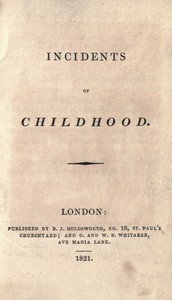
The source record for Incidents of childhood — Edition Insights measures this digital text at 28,417 words, 2 hr 4 min estimated reading time, and 13 detected text sections.
The text analysis averages about 27.0 words per sentence, while the detected sections provide another way to judge how the source is divided.
Project Gutenberg metadata also associates the work with “Conduct of life -- Juvenile fiction,” connecting these edition facts with the source record’s subject description.
Explore this collection
These alternatives are selected using recorded categories and estimated reading time.
About 127 minutes
Childrens Adventures
28,982 recorded words. 3 minutes difference from this book's estimate.
View Gutenberg source #72200About 120 minutes
Childrens Adventures
27,522 recorded words. 4 minutes difference from this book's estimate.
View Gutenberg source #71759About 119 minutes
Childrens Adventures
27,266 recorded words. 5 minutes difference from this book's estimate.
View Gutenberg source #70279Search stored excerpts and compare books → Choose by your preferences →
Choices use stored catalog measurements. Estimates vary with reading speed. A shared category is a catalog label, not a claim that two books have the same argument or literary quality.
Search reads excerpt text stored with this catalog and links to its associated Gutenberg record. The connection is stored in the site database; this tool does not recheck that every excerpt is word-for-word identical to that external record. Excerpt search does not cover every chapter and does not verify historical publication dates.
Catalog snapshot checked: 2026-09-26. Coverage: 91 public books, 91 available source excerpts.
Calculated from edition completeness, EPUB availability, text structure and catalogue metadata. Not a user rating.
Total of 100 points, scaled to a 2.5-5.0 range. Editions with an empty description or a missing EPUB file are not scored.
Public-domain source text
The source text is kept in the dedicated reader, separate from this catalogue record and its commentary.
The preface to Incidents of Childhood sets a deliberate, cautious tone: the writer aims for stories that are “familiar in their subjects as well as in their style” and “slight in their construction,” explicitly avoiding “dramatic interest” that might overexcite young readers. This restraint shapes the eight tales that follow, each built around a single moral or intellectual point. The opening story, “The Iron Box,” introduces Peter Simons, a lazy fisherman’s son, in a cottage perched on a cliff—a setting described with precise, sensory details: “the dark jagged cliff slanted up to a great height,” “rows of dried fish, of different sorts, cut open, and all shrivelled and yellow.” Such concrete imagery grounds the moral lessons in a tangible world.
In the excerpt from “The Visit to London,” a father leads his sons Henry, John, and Sam through a series of observations about St. Paul’s Cathedral. The dialogue is structured as a Socratic exercise: Henry reasons that the steps are “the proper size for us to walk up,” disproving John’s notion that past builders were giants. The father then guides them to consider the roles of knowledge, skill, and money in great works. This passage exemplifies the book’s method—using concrete, everyday evidence (steps, stones, a vessel of Portland stone) to teach logical inference and the value of cooperation. The father’s final point, that “money is the first thing requisite” for large projects, introduces economic concepts through a child’s immediate experience.
The preface declares an intention to “illustrate the minor virtues” and “exhibit the less important faults.” The stories reflect this: in “The Iron Box,” Peter’s laziness is contrasted with his parents’ industry; in “Phebe’s Visit,” a child’s curiosity is examined. The author avoids grand moral crises, focusing instead on small, repeatable choices. For instance, the father in the London episode praises Henry’s reasoning but also gently corrects John’s fanciful ideas, modeling patience and clear explanation. The tales are structured around a single fault or virtue—laziness, curiosity, temper—and resolve through conversation or a simple consequence, never through dramatic punishment or reward. This restraint aligns with the preface’s warning that “highly wrought” stories “will rarely be read without injury.”
The physical settings in Incidents of Childhood are not mere backdrops but active elements in the moral instruction. The fisherman’s cottage is described with functional precision: “steps were cut in the solid stone,” “a stack of furze to serve for firing,” nets drying on poles. This environment demands labor and resourcefulness, implicitly contrasting with Peter’s laziness. Later, the urban setting of London—Guildhall, the river wharf, St. Paul’s—provides a stage for lessons about human ingenuity and cooperation. The father points to a vessel “laden with very large blocks of Portland Stone” to challenge John’s belief in giants, substituting a lesson in engineering and economics. The settings are chosen for their ability to generate observable evidence, reinforcing the book’s commitment to teaching through the senses and reason rather than through abstract moralizing.
Incidents of Childhood rewards a reader attentive to its method: each story is a small experiment in moral and intellectual education, built from everyday materials. The author’s deliberate avoidance of strong emotion or dramatic plot means the interest lies in the precision of the observations and the clarity of the reasoning. Readers may find it useful to compare how different stories handle similar themes—for instance, how curiosity is treated in “Curiosity and Inquiry” versus “Phebe’s Visit.” The book’s value is not in suspense but in the patient, detailed unfolding of a child’s understanding.
Your answers remain private and are stored only in this browser.