About 76 minutes
Worth his while — A Reader’s Guide
Childrens Adventures
17,388 recorded words. 0 minutes difference from this book's estimate.
View Gutenberg source #72998
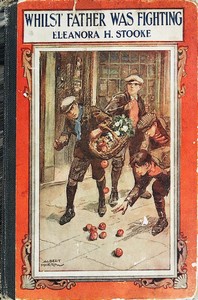
For Whilst father was fighting — A Closer Reading, the stored edition analysis reports 17,402 words, 1 hr 16 min estimated reading time, and 2 detected text sections.
The text analysis averages about 13.6 words per sentence, while the detected sections provide another way to judge how the source is divided.
Project Gutenberg metadata also associates the work with “Christian life -- Juvenile fiction,” connecting these edition facts with the source record’s subject description.
Explore this collection
These alternatives are selected using recorded categories and estimated reading time.
About 76 minutes
Childrens Adventures
17,388 recorded words. 0 minutes difference from this book's estimate.
View Gutenberg source #72998About 74 minutes
Childrens Adventures
16,854 recorded words. 2 minutes difference from this book's estimate.
View Gutenberg source #74582About 70 minutes
Childrens Adventures
16,019 recorded words. 6 minutes difference from this book's estimate.
View Gutenberg source #70922Search stored excerpts and compare books → Choose by your preferences →
Choices use stored catalog measurements. Estimates vary with reading speed. A shared category is a catalog label, not a claim that two books have the same argument or literary quality.
Search reads excerpt text stored with this catalog and links to its associated Gutenberg record. The connection is stored in the site database; this tool does not recheck that every excerpt is word-for-word identical to that external record. Excerpt search does not cover every chapter and does not verify historical publication dates.
Catalog snapshot checked: 2026-09-26. Coverage: 91 public books, 91 available source excerpts.
Calculated from edition completeness, EPUB availability, text structure and catalogue metadata. Not a user rating.
Total of 100 points, scaled to a 2.5-5.0 range. Editions with an empty description or a missing EPUB file are not scored.
Public-domain source text
The source text is kept in the dedicated reader, separate from this catalogue record and its commentary.
The first chapter, 'Afraid in the Dark,' immediately establishes the central tension of the novel: the vulnerability of children left behind during wartime. Bob Middleton, the older brother, returns to the attic he shares with his five-year-old brother Jackie, who is crying from fear of the dark. The dialogue reveals their aunt's harshness—Jackie fears being whipped with a stick—and Bob's protective resolve. The setting is a dingy Bristol street, and the boys have been living with Aunt Martha for ten months since their father, a reservist, rejoined the colours. The excerpt grounds the story in specific domestic anxieties rather than battlefield heroics.
The opening chapter introduces two key dynamics: Jackie's fear of the dark and Bob's sense of duty. Bob's first words—'Are you asleep, Jackie?'—show his care, but his reply that he has only come up for a few minutes hints at the demands placed on him. The moon is described as 'like a big lamp in the sky,' a small comfort in an otherwise grim attic. The narrative quickly establishes that the boys' mother is dead and their father is away fighting, leaving them with a childless widow who runs a greengrocer's shop and takes lodgers. The line 'Bob set his teeth and was silent for a minute' signals his suppressed anger at his aunt's treatment of Jackie. This opening primes readers to watch for how Bob balances his own needs with his promise to 'look after Jackie.'
In Chapter VIII, 'Great News,' the focus shifts to Jackie's outing with Mrs. Winter, a lodger who has become a maternal figure. The excerpt shows Mrs. Winter meeting Jackie after school and taking him to look at shop windows. Jackie's dialogue reveals his priorities: he wants to buy something for Bob, and he recalls that Bob planned to buy him a toy horse but Aunt Martha withheld the money. Mrs. Winter's decision to spend a penny on a sugar mouse for Jackie, despite her own poverty, is a quiet act of generosity. The shop girl's comment that 'paper's so dear on account of the war' grounds the story in wartime shortages. This section demonstrates how the narrative uses small, everyday moments to illustrate character and the impact of war on civilian life.
Later in the novel, the dog Stray becomes a key agent. In the excerpt, Bob hears Stray scamper down the stairs, barking excitedly, as Mrs. Winter prepares to go out. Bob reflects, 'what Jackie and I'd do without Mrs. Winter now I really don't know!' This line underscores the importance of the lodger as a surrogate parent. The dog's presence adds a note of hope and action. The chapter title 'Stray to the Rescue' (from the table of contents) suggests that the dog will play a pivotal role, though the excerpt does not reveal the specifics. The narrative here balances Bob's anxiety with the promise of help, maintaining the tension between danger and relief that runs through the book.
The novel is told in third person but stays close to the children's experiences. The dialogue is naturalistic: Jackie's 'Oh, Bobbie, Bobbie!' and his worry about being whipped convey his fear without melodrama. Bob's internal thoughts are shown through actions like setting his teeth. The setting is consistently domestic—the attic, the shop, the street—and the war is present only through its effects: absent father, rationing, and the aunt's tight budget. The table of contents reveals a plot that includes a ruby brooch, an earl's daughter, and a character named Tom Smith, but the excerpts focus on the emotional core: the bond between the brothers and the kindness of Mrs. Winter. Readers should attend to how Stooke uses small details—a pink sugar mouse, a pulled-up blind—to build a world where children cope with adult absence.
As you read, notice how the novel balances moments of fear with small comforts: the moon in the window, a penny spent on sweets, a dog's bark. The excerpts suggest that Stooke is less interested in war plots than in the daily resilience of children. Pay attention to how Bob's promise to his father—'Look after Jackie, Bob!'—shapes every decision, and how Mrs. Winter's quiet sacrifices offer a counterpoint to Aunt Martha's harshness. The incomplete excerpts leave the resolution unclear, but the pattern of threat and relief is already established.
Reading the quiet evenings in Whilst Father Was Fighting, where Bob and Jackie’s world shrinks to the lamplight and Mrs. Winter’s patient voice, I found myself thinking of another book’s tangled truths. There’s a similar hush in White and black lies — Context and Discussion, that same gentle weight of unspoken things, as if both stories understand how children hold secrets close, like warm stones in a pocket.
Capture what you thought, learned, and would like to remember.