About 225 minutes
Noel's Christmas tree — Text and Context
Childrens Adventures
51,582 recorded words. 2 minutes difference from this book's estimate.
View Gutenberg source #71664
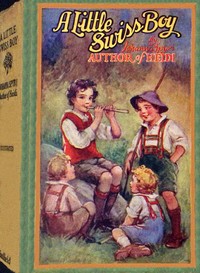
A little Swiss boy — Story, Setting & Ideas can be approached with a clearer sense of reading commitment from its source measurements: 51,138 words, 3 hr 43 min estimated reading time, and 6 detected text sections.
The text analysis averages about 16.1 words per sentence, while the detected sections provide another way to judge how the source is divided.
Project Gutenberg metadata also associates the work with “Mountain life -- Juvenile fiction,” connecting these edition facts with the source record’s subject description.
Explore this collection
These alternatives are selected using recorded categories and estimated reading time.
About 225 minutes
Childrens Adventures
51,582 recorded words. 2 minutes difference from this book's estimate.
View Gutenberg source #71664About 221 minutes
Childrens Adventures
50,679 recorded words. 2 minutes difference from this book's estimate.
View Gutenberg source #73511About 229 minutes
Childrens Adventures
52,523 recorded words. 6 minutes difference from this book's estimate.
View Gutenberg source #77259Search stored excerpts and compare books → Choose by your preferences →
Choices use stored catalog measurements. Estimates vary with reading speed. A shared category is a catalog label, not a claim that two books have the same argument or literary quality.
Search reads excerpt text stored with this catalog and links to its associated Gutenberg record. The connection is stored in the site database; this tool does not recheck that every excerpt is word-for-word identical to that external record. Excerpt search does not cover every chapter and does not verify historical publication dates.
Catalog snapshot checked: 2026-09-26. Coverage: 91 public books, 91 available source excerpts.
Calculated from edition completeness, EPUB availability, text structure and catalogue metadata. Not a user rating.
Total of 100 points, scaled to a 2.5-5.0 range. Editions with an empty description or a missing EPUB file are not scored.
Public-domain source text
The source text is kept in the dedicated reader, separate from this catalogue record and its commentary.
The June sun shines on the green slope above Leuk, where two women, Magdalen and Marianne, discuss a neighboring family with evident resentment. Magdalen criticizes the family's pride, noting their Sunday-best dress and the boy's curled black hair. Yet Marianne observes that the house, once gray and grimy, now gleams white—a physical change that hints at transformation beneath the surface. This opening establishes a world where appearances and judgments intertwine, setting the stage for a story that will test assumptions about character and worth.
Vinzi, the Swiss boy of the title, possesses an innate musical ability that connects him to his grandfather. When the grandfather cannot recall a hymn's tune, Vinzi composes one himself, explaining, “That came to me because I wanted to sing the hymn you could no longer remember.” The grandfather, moved, arranges for Vinzi to receive the hymn's lyrics from Father Silvanus, with the condition that Vinzi sing it back. This exchange underscores how music functions not as mere entertainment but as a means of preserving memory and fostering intimacy across age gaps. The grandfather's gift of food to the singing boys further emphasizes that music is a communal offering, repaid with hospitality.
The catalog subject “Domestic fiction” is evident in the early dialogue between Magdalen and Marianne, where pride is the central grievance. Magdalen accuses the neighboring family of being “eaten up with pride,” citing their dress, the boy's curled hair, and the girl's demeanor. Yet Marianne offers a counterpoint: “The little girl can't help it if her nose turns up.” This exchange reveals that pride is in the eye of the beholder, and the narrative does not immediately validate either perspective. The house's transformation from gray to white suggests that renewal is possible, but the social friction remains a undercurrent that may shape events.
The excerpts repeatedly emphasize the physical landscape: the green slope, the cool grass, the alpine roses. When Vinzi receives the hymn, he retreats to a “sunny field” of alpine roses to read the words and let the melody come to him. The setting is not backdrop but active participant—the cascade “foams from rocky height,” the peaks “proudly stand.” The hymn's lyrics themselves celebrate the natural world: “Behold on high in beaming sun / The glowing clouds like roses.” Vinzi's connection to place is integral to his creative process; he cannot compose in the midst of the crowd but must ascend to solitude. This aligns with the catalog subject “Mountain life,” showing how the environment shapes both daily life and inner experience.
Readers should attend to how the excerpts position music and nature as intertwined forces that challenge social hierarchies. The opening gossip about pride may be tested by Vinzi's humility and his grandfather's generosity. The hymn's words—contrasting mortal frailty with eternal peaks—offer a thematic key. The story's resolution is not given here, but the groundwork is laid for a narrative where a boy's gift might reconcile divisions within his community.
Vinzi’s quiet tune, rising between the old pews, made me think of my own small melody—a childhood hum I’d nearly forgotten. Then I recalled the windswept stillness of Excursion to the Orkney Islands — A Reader’s Guide, which similarly held a lonely note that felt like home. Some books simply echo what we already carry.
Your answers remain private and are stored only in this browser.