About 203 minutes
White and black lies — Context and Discussion
Childrens Adventures
46,592 recorded words. 1 minutes difference from this book's estimate.
View Gutenberg source #73637
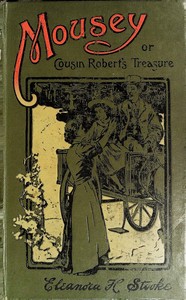
The catalog record for Mousey — Themes and Context provides practical reading context through 46,413 words, 3 hr 22 min estimated reading time, and 5 detected text sections.
The text analysis averages about 15.1 words per sentence, while the detected sections provide another way to judge how the source is divided.
Project Gutenberg metadata also associates the work with “Christian life -- Juvenile fiction,” connecting these edition facts with the source record’s subject description.
Explore this collection
These alternatives are selected using recorded categories and estimated reading time.
About 203 minutes
Childrens Adventures
46,592 recorded words. 1 minutes difference from this book's estimate.
View Gutenberg source #73637About 201 minutes
Childrens Adventures
46,229 recorded words. 1 minutes difference from this book's estimate.
View Gutenberg source #73681About 205 minutes
Childrens Adventures
47,043 recorded words. 3 minutes difference from this book's estimate.
View Gutenberg source #71176Search stored excerpts and compare books → Choose by your preferences →
Choices use stored catalog measurements. Estimates vary with reading speed. A shared category is a catalog label, not a claim that two books have the same argument or literary quality.
Search reads excerpt text stored with this catalog and links to its associated Gutenberg record. The connection is stored in the site database; this tool does not recheck that every excerpt is word-for-word identical to that external record. Excerpt search does not cover every chapter and does not verify historical publication dates.
Catalog snapshot checked: 2026-09-26. Coverage: 91 public books, 91 available source excerpts.
Calculated from edition completeness, EPUB availability, text structure and catalogue metadata. Not a user rating.
Total of 100 points, scaled to a 2.5-5.0 range. Editions with an empty description or a missing EPUB file are not scored.
Public-domain source text
The source text is kept in the dedicated reader, separate from this catalogue record and its commentary.
The novel begins not with Mousey herself but with a family conference held after her mother's funeral, where relatives debate the orphan's future. The first chapter establishes Mousey's character through her restrained grief: she 'bravely choked down her sobs' while her aunt misreads her composure as lack of feeling. This early misjudgment by adults sets a pattern of misunderstanding that the narrative will explore.
Stooke's prose moves between Mousey's internal experience and the practical concerns of the adults, grounding the story in tangible details—the 'horse-hair sofa,' the 'few bits of poor furniture,' and the presence of Cousin Robert, a watchmaker whose shabby green coat becomes a recurring motif. The excerpts suggest that Mousey's quiet influence on her miserly relative unfolds through small, domestic exchanges rather than dramatic events.
The opening chapter places Mousey in a room full of adults who discuss her future as if she were not present. Stooke emphasizes the child's acute awareness of being an object of pity: Mousey 'looked timidly around on the faces which were turned towards her full of pity, conscious that this was a crisis in her life.' The narrative voice stays close to Mousey's limited understanding, noting that she 'knew must be her mother's cousin' when she sees Robert Harding, but never granting her full knowledge of the adults' plans.
This restricted viewpoint creates a tension between what Mousey perceives and what the reader infers. The adults' conversation is not directly quoted in the excerpts, but their presence and the weight of their decisions are felt through Mousey's physical reactions—her timid glances, her restrained tears. Stooke uses this technique to align the reader with the child's vulnerability while also hinting at the broader social dynamics of orphanhood in Edwardian England.
A later excerpt shows Mousey alone with Cousin Robert, where a conversation about his worn clothing becomes a pivotal scene. When Mousey asks, 'Does it cost much to buy a suit of clothes?' and then examines the faded coat and shabby buttons, she crosses a boundary: 'Is it your place to question me?' Robert demands. Yet her tears and confession—'I can't bear to hear unkind things said about you'—move him in a way that direct argument could not.
Stooke uses the suit as a concrete symbol of Robert's miserliness and his isolation. The scene reveals that Mousey's influence is not through persuasion but through her genuine distress at others' mockery. Robert's decision to order a new suit—'You can inform Maria that I'll pay a visit to a tailor'—marks a small but significant shift, one that the narrative attributes to Mousey's emotional honesty rather than any calculated strategy.
The excerpts repeatedly return to the household's material conditions: the 'horse-hair sofa,' the 'old suit of clothes,' the 'parlour table.' Stooke embeds moral instruction within these domestic details. When Maria the servant scoffs at the old suit, Robert accuses her of 'a love for fine clothes,' but Mousey's intervention reframes the issue: she cares not about fashion but about the unkindness of others' laughter.
This scene exemplifies the novel's method: a moral point about charity, thrift, or kindness arises naturally from a concrete situation. The catalog subject 'Conduct of life' is thus dramatized through Mousey's interactions with adults, not preached in abstract terms. The reader observes how Mousey's quiet persistence—asking questions, showing distress—gradually softens Robert's resistance, suggesting that virtue is demonstrated through small, repeated actions rather than grand gestures.
Based on the excerpts, Stooke structures the novel around a series of domestic scenes that build incrementally. The opening conference, the conversation about the suit, and the arrival of the new clothes on Saturday night all occur within a confined setting—the parlour, the kitchen—with a limited cast. This focus on interior spaces and daily routines creates a rhythm of quiet tension and small resolutions.
The reader is invited to watch for patterns: Mousey's tears, Robert's impatience, Maria's sarcasm. Each character's voice is distinct, and their conflicts arise from personality clashes rather than external events. The excerpts do not reveal whether Robert's transformation will be sustained or whether Mousey will face further trials, but they establish a clear trajectory: the orphan's presence acts as a catalyst for change in a household defined by habit and stinginess. The novel's moral arc is thus embedded in its domestic realism.
Readers approaching Mousey for the first time will find a story that rewards attention to small gestures and repeated details. Stooke's prose is plain but precise, and the moral lessons emerge from character interaction rather than authorial commentary. Pay particular attention to how objects—clothes, furniture, money—carry emotional weight, and how Mousey's quietness is itself a form of agency. The novel's title hints at her perceived insignificance, but the excerpts suggest that her influence, like a mouse's, is felt in subtle but persistent ways.
This made me think of my grandmother’s quiet frugality, the way she’d mend a sleeve instead of buying new. Reading about Mousey’s gentle economies felt like sitting in that hushed kitchen again. Another soft, odd comfort came later from Poppy Ott and the galloping snail — A Closer Reading, which held a similar, unhurried patience for small things—a snail’s pace, a watchmaker’s tools, the slow warmth of noticing.
Use these questions to collect your thoughts before moving on.