About 207 minutes
Nelly — Context and Discussion
Childrens Adventures
47,476 recorded words. 2 minutes difference from this book's estimate.
View Gutenberg source #71244
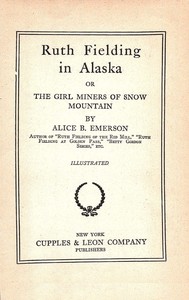
For Ruth Fielding in Alaska — Text and Context, the stored edition analysis reports 47,043 words, 3 hr 25 min estimated reading time, and 32 detected text sections.
The text analysis averages about 15.7 words per sentence, while the detected sections provide another way to judge how the source is divided.
Project Gutenberg metadata also associates the work with “Alaska -- Juvenile fiction,” connecting these edition facts with the source record’s subject description.
Explore this collection
These alternatives are selected using recorded categories and estimated reading time.
About 207 minutes
Childrens Adventures
47,476 recorded words. 2 minutes difference from this book's estimate.
View Gutenberg source #71244About 203 minutes
Childrens Adventures
46,592 recorded words. 2 minutes difference from this book's estimate.
View Gutenberg source #73637About 202 minutes
Childrens Adventures
46,413 recorded words. 3 minutes difference from this book's estimate.
View Gutenberg source #70697Search stored excerpts and compare books → Choose by your preferences →
Choices use stored catalog measurements. Estimates vary with reading speed. A shared category is a catalog label, not a claim that two books have the same argument or literary quality.
Search reads excerpt text stored with this catalog and links to its associated Gutenberg record. The connection is stored in the site database; this tool does not recheck that every excerpt is word-for-word identical to that external record. Excerpt search does not cover every chapter and does not verify historical publication dates.
Catalog snapshot checked: 2026-09-26. Coverage: 91 public books, 91 available source excerpts.
Calculated from edition completeness, EPUB availability, text structure and catalogue metadata. Not a user rating.
Total of 100 points, scaled to a 2.5-5.0 range. Editions with an empty description or a missing EPUB file are not scored.
Public-domain source text
The source text is kept in the dedicated reader, separate from this catalogue record and its commentary.
The opening chapter introduces Ruth Fielding not as a schoolgirl or adventurer but as a film director under pressure. A letter from Sol Bloomberg, a rival, visibly worries her—her friend Helen Cameron teases her about a scowl that might “freeze on your face.” This threat sets the plot in motion: Ruth is leading a moving picture company to Alaska to film a picture called “The Girl of Gold.” The excerpts reveal a protagonist who is both determined and anxious, aware that her crew is “on probation” and that she must prove her ability. The setting shifts quickly from a domestic scene to the raw landscape of Knockout Point, a half-abandoned settlement at the base of Snow Mountain.
Ruth Fielding is no longer the girl of the Red Mill; she is a motion picture producer and director. The excerpts show her grappling with professional stakes. When her crew arrives at Knockout Inn, she asks about their quarters and finds them “well satisfied” except for Joe Rumph, who “merely glowered and said nothing.” This detail hints at internal friction. Ruth senses she is “on probation” and must prove her ability to film a picture worthy of the title “The Girl of Gold.” The narrative voice emphasizes her resolve: “I’ll show them!” she thinks. This is not a casual adventure but a career-making project, with a rival (Sol Bloomberg) actively threatening her success.
The setting is described with a mix of awe and disdain. Knockout Point is a “half-abandoned settlement” with shabby stores, a few houses, and a dance hall and gambling den called The Big Chance. The inn itself is bare: a dining room with “rough-hewn tables,” a living room with an immense fireplace, faded cushions, and animal skins on the walls. An old sideboard is noted as a curiosity. Ruth and Helen find the town’s rundown appearance at odds with the “scenic grandeur” of Snow Mountain, which is “capped with ice all the year round.” The contrast between the crude buildings and the majestic mountain underscores the challenge of filming in such a place—and the potential for striking visuals.
Though the catalog subjects list gold mining as a key theme, the excerpts offer only indirect evidence. The subtitle “The Girl Miners of Snow Mountain” suggests mining will play a role, but the provided text focuses on the film company’s arrival and Ruth’s directorial anxieties. One scene describes a stranger rising from a shadowy corner of the inn, startling the girls, but no mining activity appears. The presence of a dance hall and gambling den hints at the rough frontier life. Readers should expect that mining becomes central later, but the excerpts do not confirm how—whether as a plot device, a backdrop, or a source of conflict with Bloomberg.
These excerpts establish Ruth Fielding as a capable but untested director, not merely a tourist in Alaska. The tension with Sol Bloomberg and the crew’s skepticism create a professional drama beneath the adventure surface. Pay attention to how the setting—both the ramshackle town and the majestic mountain—shapes the story’s mood. The incomplete picture of the mining element invites curiosity about how the “girl miners” will emerge.
I keep thinking about Ruth Fielding, steering her whole film company through that Alaskan wilderness, every shot contested by weather and rivals alike. There’s a particular stubbornness in her quiet perseverance that reminds me of another favorite, the gentle determination captured in Noel's Christmas tree — Text and Context. Both feel like old friends I visit when the year grows gray, their winters somehow warmer than my own.
Save your reaction, strongest insight, and memorable passage.