About 261 minutes
Third Base Thatcher — Edition Insights
Childrens Adventures
59,863 recorded words. 4 minutes difference from this book's estimate.
View Gutenberg source #70640
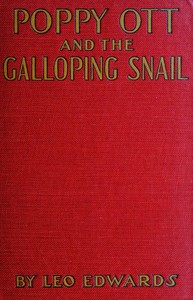
Poppy Ott and the galloping snail — A Closer Reading can be approached with a clearer sense of reading commitment from its source measurements: 58,893 words, 4 hr 17 min estimated reading time, and 36 detected text sections.
The text analysis averages about 13.8 words per sentence, while the detected sections provide another way to judge how the source is divided.
Project Gutenberg metadata also associates the work with “Humorous stories,” connecting these edition facts with the source record’s subject description.
Explore this collection
These alternatives are selected using recorded categories and estimated reading time.
About 261 minutes
Childrens Adventures
59,863 recorded words. 4 minutes difference from this book's estimate.
View Gutenberg source #70640About 253 minutes
Childrens Adventures
58,137 recorded words. 4 minutes difference from this book's estimate.
View Gutenberg source #71590About 264 minutes
Childrens Adventures
60,653 recorded words. 7 minutes difference from this book's estimate.
View Gutenberg source #67989Search stored excerpts and compare books → Choose by your preferences →
Choices use stored catalog measurements. Estimates vary with reading speed. A shared category is a catalog label, not a claim that two books have the same argument or literary quality.
Search reads excerpt text stored with this catalog and links to its associated Gutenberg record. The connection is stored in the site database; this tool does not recheck that every excerpt is word-for-word identical to that external record. Excerpt search does not cover every chapter and does not verify historical publication dates.
Catalog snapshot checked: 2026-09-26. Coverage: 91 public books, 91 available source excerpts.
Calculated from edition completeness, EPUB availability, text structure and catalogue metadata. Not a user rating.
Total of 100 points, scaled to a 2.5-5.0 range. Editions with an empty description or a missing EPUB file are not scored.
Public-domain source text
The source text is kept in the dedicated reader, separate from this catalogue record and its commentary.
The story opens with Jerry Todd dragging himself off a sun-baked highway, so hot he feels “like a fried egg.” His first-person voice is immediate and slangy, full of wisecracks and self-deprecating asides. He introduces Poppy Ott as the real brains behind their stilt-making business, now on a hitch-hike vacation. The narrative moves quickly from a comic, overheated start to a house of mystery, where a slamming door and a spotted gander set the puzzle in motion.
The book begins not with a mystery but with a boy exhausted by summer heat. Jerry Todd’s narration is colloquial and exaggerated: he recites a mangled poem, kicks off his shoes, and begs for ice cream. This opening establishes a tone of humorous exaggeration that persists even as the plot turns eerie. The setting is a concrete highway in Illinois, and the boys are on a hitch-hike vacation after their successful stilt business. The contrast between the mundane road and the looming mystery of the stone house is sharp. Jerry’s voice is central: he describes himself as “all fagged out” and the bush as “skinny,” giving the prose a concrete, sensory quality. The reader is grounded in Jerry’s physical discomfort before any hint of the supernatural or criminal appears.
Two recurring images anchor the mystery: a spotted gander and a doctor with “boring eyes.” The gander appears early and is repeatedly questioned about—Poppy asks if anyone keeps a gander as a pet, and the local response is disbelief: “Them things people don’t make pets of.” The doctor, Dr. Madden, is described with thin face and eagle eyes that seem always searching. Jerry’s internal monologue connects these images: “Did he have the crazy idea that there was some secret connection between the returned doctor and the puzzling spotted gander?” The text uses repetition of the word “something” to build uncertainty. The doctor’s eyes are linked to the millionaire’s sudden death and a possible search for an unknown object. The gander, the doctor, and the granddaughter all arrived in the neighborhood around the same time, hinting at a hidden pattern.
The story’s structure relies on swift movement between locations: the highway, the stone house, and a car ride with old Goliath. Chapter XIII opens with Jerry noting the car’s erratic driving—“we very nicely tried to rainbow over a tree”—and then arriving at the house for a planned midnight vigil. The boys’ plans are repeatedly disrupted by Fate, as Jerry puts it. The car journey itself becomes a scene of comic danger and tension. The house is described as a “shebang” and a “shack,” deflating its Gothic potential. This constant motion—from road to house to car and back—keeps the mystery dynamic. The boys are always arriving or departing, never settled. The slamming door is a fixed point they try to reach, but the narrative keeps them moving, delaying the reveal.
Jerry Todd is not just a narrator but a character who speculates openly. In Chapter XII, his thoughts run wild: “Could it be… that the doctor had known that we were heading for the big house… And didn’t he want us there?” He asks himself a series of questions about the doctor’s motives, the gander, and the granddaughter. The text uses italics and dashes to convey his jumping thoughts: “Crickets! Maybe they did connect up, was my jumping thought.” This internal questioning gives the reader access to the mystery’s development without revealing answers. Jerry’s speculations are often wrong or incomplete, but they drive the plot forward. His voice remains colloquial even in these moments, saying “Crickets!” and “Boy, was I ever hot!” The combination of humor and genuine puzzlement keeps the tone light while the mystery deepens.
Readers should pay attention to the way the narrative shifts between Jerry’s comic asides and the growing tension of the locked-room puzzle. The recurring images—the gander, the doctor’s eyes, the slamming door—are not merely decorative but structural, each reappearing at key moments. The book rewards close attention to what characters say they don’t know, as much as what they reveal.
Rereading Poppy Ott and the Galloping Snail, I caught myself smiling at how quietly the boys trust each other—no grand speeches, just shared glances at that slamming door. It reminded me of another summer, another logbook, where a young voice faced the unknown with the same steady wonder. Leaves from a middy's log — A Closer Reading holds that same unhurried pulse, like waves against a hull I once knew.
Build a private reading journal entry for this title.