About 215 minutes
The ocean wireless boys of the iceberg patrol — Story, Setting & Ideas
Childrens Adventures
49,428 recorded words. 2 minutes difference from this book's estimate.
View Gutenberg source #69517
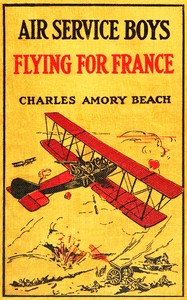
The catalog record for Air Service boys flying for France — Story, Setting & Ideas provides practical reading context through 48,923 words, 3 hr 33 min estimated reading time, and 31 detected text sections.
The text analysis averages about 20.4 words per sentence, while the detected sections provide another way to judge how the source is divided.
Project Gutenberg metadata also associates the work with “Aeronautics -- Juvenile fiction,” connecting these edition facts with the source record’s subject description.
Explore this collection
These alternatives are selected using recorded categories and estimated reading time.
About 215 minutes
Childrens Adventures
49,428 recorded words. 2 minutes difference from this book's estimate.
View Gutenberg source #69517About 210 minutes
Childrens Adventures
48,137 recorded words. 3 minutes difference from this book's estimate.
View Gutenberg source #68624About 208 minutes
Childrens Adventures
47,817 recorded words. 5 minutes difference from this book's estimate.
View Gutenberg source #71175Search stored excerpts and compare books → Choose by your preferences →
Choices use stored catalog measurements. Estimates vary with reading speed. A shared category is a catalog label, not a claim that two books have the same argument or literary quality.
Search reads excerpt text stored with this catalog and links to its associated Gutenberg record. The connection is stored in the site database; this tool does not recheck that every excerpt is word-for-word identical to that external record. Excerpt search does not cover every chapter and does not verify historical publication dates.
Catalog snapshot checked: 2026-09-26. Coverage: 91 public books, 91 available source excerpts.
Calculated from edition completeness, EPUB availability, text structure and catalogue metadata. Not a user rating.
Total of 100 points, scaled to a 2.5-5.0 range. Editions with an empty description or a missing EPUB file are not scored.
Public-domain source text
The source text is kept in the dedicated reader, separate from this catalogue record and its commentary.
The opening lines of Air Service Boys Flying for France immediately establish a pattern of observation and distance. Jack tells Tom, “I’m going to keep you in focus with my binoculars every minute of the time,” a phrase that recurs as a motif of watching from afar. This tension between the desire to be in action and the necessity of watching—whether through binoculars, from a boat deck, or from the air—runs through the excerpts. The boys’ eagerness to “get a whack at the Kaiser” is repeatedly checked by reminders of the war’s grimness, such as the “heart-rending scenes” of devastated districts and the “grimness and secrecy” of wartime travel.
The excerpts reveal a persistent contrast between the protagonists’ enthusiasm and the sobering circumstances they encounter. Jack declares he wants to “finish my schooling and be sent to the front” and “raiding German cities,” but Tom corrects him, noting that the Lafayette Escadrille does not engage in that sort of work—their business is to engage German airplanes and control artillery fire. This correction underscores a gap between the boys’ romanticized view of war and the specialized, tactical reality of aerial combat. Similarly, the crossing from Dover to Calais is described with “utmost vigilance,” with passengers wearing life belts and remaining on deck, expecting submarines. The narrative voice notes that “every little sound, every little wave slapping against the side of the boat, seemed to the excited passengers to mean sudden peril.” The word “excited” here is telling: it suggests a thrill that coexists with fear, a duality that the book explores.
The aviation school is presented as a place of both opportunity and impatience. Tom has been “in the harness at the aviation field for only two months” and is already trying for altitude, while Jack admits the “germ” of flying has caught him. Yet the path to the front is not direct: there is “more or less red tape” crossing the Channel, and the boys must pass through “customary formalities” to ensure they are not spies. The novel’s structure, as seen in the chapter titles, moves from school to secret sailing, then to perils at sea, a Zeppelin raid, and finally to the French flying school and the Lafayette Escadrille. This progression suggests that the real challenge is not just learning to fly but navigating the bureaucratic and dangerous journey to the front. The excerpts show that the boys’ training is repeatedly interrupted by the war itself—submarines, spies, and air raids—making the school a fragile sanctuary.
Binoculars, life belts, and the act of watching are recurring details. Jack’s promise to keep Tom “in focus with my binoculars” is echoed later when passengers “remained on deck every minute of the time” watching for submarines. The narrative emphasizes visibility and its limits: lights are extinguished, the night is gloomy, and the boat proceeds in darkness. Even the air service boys’ eventual role—keeping “in constant touch with the advancing troops” and controlling fire through signals—is a form of observation. This motif creates a tension between the desire to act and the necessity of watching, a theme that likely persists throughout the book. The excerpts do not reveal whether the boys ever engage in direct combat, but the emphasis on observation suggests that their primary function may be to see and report rather than to fight.
Readers approaching this 1918 boys’ adventure should note that the excerpts present a war story filtered through a lens of youthful enthusiasm, but with persistent undercurrents of danger and discipline. The book’s value lies not in its historical accuracy but in its portrayal of how young Americans imagined their role in the Great War—eager, observant, and caught between training and action. The tension between the boys’ impatience and the war’s demands is the engine of the narrative.
I kept thinking about how those boys saw the war through their binoculars—always watching from a distance, never quite touching what they saw. That ache of observation stayed with me long after. I found a similar quiet longing in Three girl chums at Laurel Hall — Reading Companion, where the girls watch each other’s lives unfold from just outside the frame. It’s a gentler kind of distance, but it lingers the same way. Just a feeling worth carrying for a while.
Your answers remain private and are stored only in this browser.