About 100 minutes
Grandfer's wonderful garden — A Closer Reading
Childrens Adventures
22,924 recorded words. 6 minutes difference from this book's estimate.
View Gutenberg source #71476
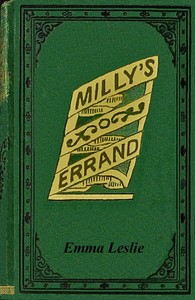
The catalog record for Milly's errand — Reading Notes provides practical reading context through 21,610 words, 1 hr 34 min estimated reading time, and 3 detected text sections.
The text analysis averages about 18.4 words per sentence, while the detected sections provide another way to judge how the source is divided.
Project Gutenberg metadata also associates the work with “Christian life -- Juvenile fiction,” connecting these edition facts with the source record’s subject description.
Explore this collection
These alternatives are selected using recorded categories and estimated reading time.
About 100 minutes
Childrens Adventures
22,924 recorded words. 6 minutes difference from this book's estimate.
View Gutenberg source #71476About 85 minutes
Childrens Adventures
19,346 recorded words. 9 minutes difference from this book's estimate.
View Gutenberg source #72132About 110 minutes
Childrens Adventures
25,145 recorded words. 16 minutes difference from this book's estimate.
View Gutenberg source #68584Search stored excerpts and compare books → Choose by your preferences →
Choices use stored catalog measurements. Estimates vary with reading speed. A shared category is a catalog label, not a claim that two books have the same argument or literary quality.
Search reads excerpt text stored with this catalog and links to its associated Gutenberg record. The connection is stored in the site database; this tool does not recheck that every excerpt is word-for-word identical to that external record. Excerpt search does not cover every chapter and does not verify historical publication dates.
Catalog snapshot checked: 2026-09-26. Coverage: 91 public books, 91 available source excerpts.
Calculated from edition completeness, EPUB availability, text structure and catalogue metadata. Not a user rating.
Total of 100 points, scaled to a 2.5-5.0 range. Editions with an empty description or a missing EPUB file are not scored.
Public-domain source text
The source text is kept in the dedicated reader, separate from this catalogue record and its commentary.
Emma Leslie opens Milly's Errand; or, Saved to Save with a storm brewing off a dangerous coast, an old sailor scanning the horizon. The first chapter introduces two fisher-boys gathering seaweed for Dr. Mansfield, a wealthy but miserably reclusive physician. Their dialect-laden conversation—'he ain't more 'n thirty, or forty at the most'—immediately establishes a community wary of the doctor's gray hair and puckered face. The narrative voice shifts between blunt, colloquial exchanges and a more formal, omniscient tone that describes the doctor's 'gloomy melancholy.' This dual register sets up a central tension: the doctor's isolation versus the village's pressing needs.
The opening chapters rely heavily on dialect to mark social boundaries. The fisher-boys speak in contractions and dropped consonants: 'It's a pity he ain't poor, and got to work for a poor old mother like we have, Jack.' Their speech is immediate, rhythmic, and tied to physical labor—dragging wet seaweed, worrying about a blanket. In contrast, the doctor's dialogue, when it appears, is terse and formal: 'he told her, shortly, he had not come to see the place, but the children.' The narrator often glosses the boys' words with explanatory tags ('said his brother, likewise stopping to rest'), slowing the pace to clarify meaning. This technique keeps the reader aware of a gap between the characters' lived experience and the narrator's interpretive frame.
Leslie controls narrative speed through the doctor's gradual re-engagement. His first 'errand of mercy' is described in a single, swift paragraph: he leaves medicine, orders arrow-root, and departs 'before a word of thanks could be uttered.' The next paragraph compresses several months into a summary: 'For several months the doctor had no time to indulge his gloomy melancholy.' This acceleration mirrors his absorption into village life. Later, when Milly has lived with him for two years, the pace slows again to accommodate the doctor's backstory in Chapter VIII. The shift from rapid summary to detailed scene marks his emotional thaw—the narrative itself becomes less hurried as he becomes less haunted.
Milly enters the story as a silent, lashed-to-wreckage foundling—an object of rescue. Her first spoken words are not recorded; instead, the narrator reports her effect: the doctor 'stooped and kissed the little girl.' Leslie uses Milly's presence to alter the doctor's speech patterns. Where he once spoke 'sharply and gruffly,' he now asks 'in a shy manner, as though he were half ashamed of the kindness he was showing.' The narrative voice itself softens, adopting words like 'gentleness' and 'brightened.' Milly's own voice remains largely unreported in the excerpts, making her a quiet fulcrum: the story's pacing and register change around her without her needing to speak.
Readers attentive to voice will notice how Leslie uses dialect not merely for color but as a measure of distance—between classes, between isolation and community. The doctor's trajectory from curt commands to hesitant kindness is charted through shifts in narrative tempo. Milly's silence, paradoxically, becomes the loudest signal of transformation. The novel rewards a careful ear for who speaks, how, and when the narrator chooses to hurry or linger.
I’ve often thought Milly’s Errand holds a private sort of warmth, the way Dr. Mansfield’s stormy edges soften by slow degrees. A similar quietness lives in Hitting the line — Inside the Classic, where discipline meets a gentler understanding. Both feel like old friends who spoke less, yet said more, in their patient turning of pages.
Answer a few questions and save a private reflection on this device.