About 70 minutes
A little town mouse — Story, Setting & Ideas
Childrens Adventures
16,019 recorded words. 0 minutes difference from this book's estimate.
View Gutenberg source #70922
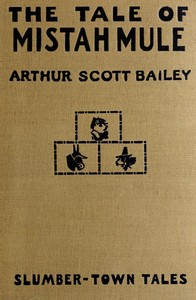
For The tale of Mistah Mule — A Closer Reading, the stored edition analysis reports 16,000 words, 1 hr 10 min estimated reading time, and 32 detected text sections.
The text analysis averages about 12.4 words per sentence, while the detected sections provide another way to judge how the source is divided.
Project Gutenberg metadata also associates the work with “Animals -- Juvenile fiction,” connecting these edition facts with the source record’s subject description.
Explore this collection
These alternatives are selected using recorded categories and estimated reading time.
About 70 minutes
Childrens Adventures
16,019 recorded words. 0 minutes difference from this book's estimate.
View Gutenberg source #70922About 74 minutes
Childrens Adventures
16,854 recorded words. 4 minutes difference from this book's estimate.
View Gutenberg source #74582About 76 minutes
Childrens Adventures
17,402 recorded words. 6 minutes difference from this book's estimate.
View Gutenberg source #70920Search stored excerpts and compare books → Choose by your preferences →
Choices use stored catalog measurements. Estimates vary with reading speed. A shared category is a catalog label, not a claim that two books have the same argument or literary quality.
Search reads excerpt text stored with this catalog and links to its associated Gutenberg record. The connection is stored in the site database; this tool does not recheck that every excerpt is word-for-word identical to that external record. Excerpt search does not cover every chapter and does not verify historical publication dates.
Catalog snapshot checked: 2026-09-26. Coverage: 91 public books, 91 available source excerpts.
Calculated from edition completeness, EPUB availability, text structure and catalogue metadata. Not a user rating.
Total of 100 points, scaled to a 2.5-5.0 range. Editions with an empty description or a missing EPUB file are not scored.
Public-domain source text
The source text is kept in the dedicated reader, separate from this catalogue record and its commentary.
The story begins not with a gentle introduction but with a kick. When Mistah Mule is led into the barn, his first act is to try to kick old horse Ebenezer, who had merely asked his name. The farmyard erupts—Spot yelps, Henrietta Hen clucks, Turkey Proudfoot gobbles—and even Farmer Green gets kicked, prompting Mistah Mule to laugh. This opening establishes a pattern: the mule's behavior is a series of provocations and reactions, often framed as jokes by the narrator but taken seriously by the other animals.
Bailey's prose moves briskly through dialogue and action, with each chapter a self-contained episode. The mule's speech is marked by a distinctive dialect—"What for you does that?"—and his moods shift between laziness, defiance, and occasional cooperation. The excerpts show a creature who is both a source of chaos and a figure of grudging admiration, as when Johnnie Green notes his "sleek black coat" and "fashionable" trot.
Mistah Mule's first appearance is defined by a single gesture: kicking. He kicks Ebenezer, then Farmer Green, and the laughter that follows—"Hee-haw! Hee-haw!"—marks him as an outsider who delights in upsetting order. The farm animals react with alarm: old dog Spot tucks his tail and flees. This pattern recurs throughout the excerpts: the mule uses physical force or stubborn refusal to assert himself, and the other characters must adapt.
Bailey does not moralize directly, but the consequences are clear. When Mistah Mule balks on the hill, Johnnie Green is stranded for hours, and Farmer Green must come searching. The mule's behavior is not merely mischievous; it disrupts work and errands. Yet the narrator's tone remains light, treating each incident as a "joke" or a "trick." This tension between the mule's disruptive actions and the story's comic framing is a key feature of the text.
The excerpts also show that Mistah Mule's kicking is not random. He kicks when approached without ceremony, as when Ebenezer "made myself known to him." This suggests a boundary: the mule demands a certain respect or distance, and he enforces it physically.
Bailey gives each animal a distinct voice, but Mistah Mule's speech is the most marked. He uses nonstandard grammar: "What for you does that?" and "My mother told me to run." This dialect sets him apart from the other animals, who speak in standard English. It also aligns him with the folk tradition of talking animals who are both comic and canny.
The other animals react to him with a mix of fear and curiosity. Miss Kitty Cat asks eager questions; Ebenezer speaks with "great disgust." The hired man and Farmer Green use plain, practical language. Johnnie Green, when faced with the balky mule, shifts from coaxing to frustration: "Get along, there!" and "My goodness!"
This variety of voices creates a social world where status is negotiated through speech. Mistah Mule's dialect is not just a quirk; it signals his role as an outsider who does not fully belong to the farm's hierarchy. Yet he is also capable of silence—when he balks, he simply stops and stares, letting his body do the talking.
The most extended episode in the excerpts is the balking on the hill. Mistah Mule trots briskly at first, but as the sun beats down and the hill lengthens, he slows, then stops. Johnnie's commands are met with a turned head and laid-back ears. The mule's refusal is not passive; it is a deliberate, almost theatrical display of will.
Bailey describes the mule's body language precisely: head droops, ears flop, feet move slowly. When Johnnie tries to lead him, "that stubborn fellow wouldn't stir." The standoff lasts two hours, until Farmer Green arrives. This scene echoes the earlier kicking: both are forms of resistance that force others to adjust.
The narrative does not explain why Mistah Mule balks—whether from laziness, heat, or spite. The ambiguity is part of the pattern. The mule's motives remain opaque, and the other characters can only guess. This makes him unpredictable, a source of both frustration and fascination. The story's humor depends on this unpredictability: the reader, like Johnnie, never knows what the mule will do next.
Readers may find it useful to track how Mistah Mule's behavior shifts across chapters—from the initial kicking to the balking episode and the hints of improvement noted by the farm. The excerpts do not reveal whether he changes permanently, but they show a creature who is both a problem and a personality. Pay attention to the small details: the way he laughs, the way he stares, the way he moves his "small, narrow feet." These are the clues to understanding a character who resists easy judgment.
Reading about Mistah Mule’s stubborn refusal to budge, I remembered sitting on a stone wall near our old orchard, feeling just as balky about the world. Then A little Swiss boy — Story, Setting & Ideas crossed my path, and that same quiet, immovable feeling seemed gentler, less lonely. He resisted too, and somehow that made my own stubbornness feel like a beginning, not an end. A little Swiss boy — Story, Setting & Ideas simply sat with me that afternoon.
Your answers remain private and are stored only in this browser.